


What is your evidence for that?
There is hardly a more basic question in journalism. President Trump does not like it. In five notable instances where he broke off an exchange with a journalist rather than answer, it was over the same demand: stand behind the thing you just said. Show me how you know.
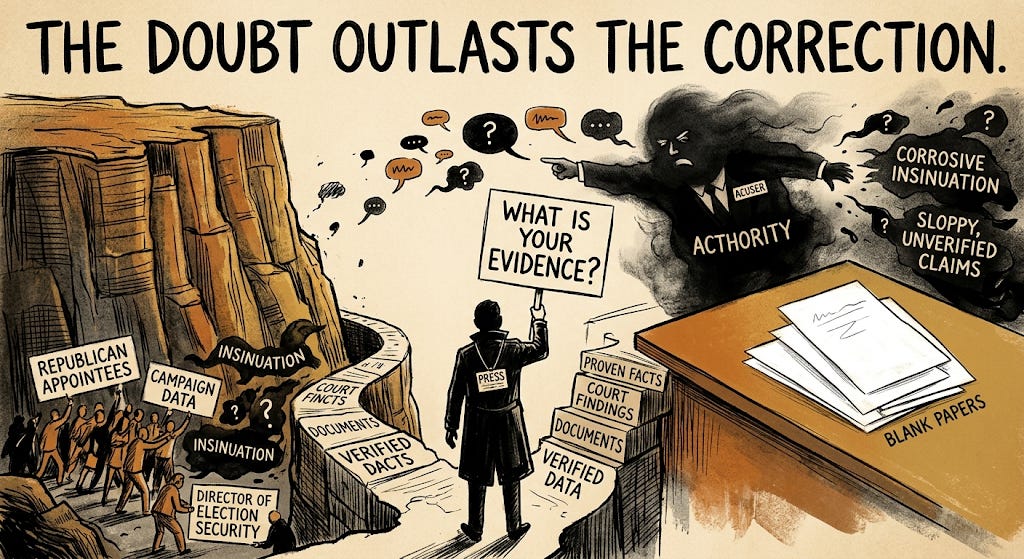
One hundred days into his first term, in 2017, I asked him why he had called Barack Obama 'sick and bad'— the essence of a charge he had repeated to me, something he said 'frankly, should be discussed. So I tried to discuss it. What did he mean? He ended the Oval Office interview and returned to his desk and appeared to read from papers that were blank.
In October 2020, Lesley Stahl pressed him on his claim that his 2016 campaign had been spied on, part of what he portrayed as sweeping fraud organized by the Obama campaign. His response offered no proof, only directions to where proof was supposedly hiding: “Just go down and get the papers. They spied on my campaign, they got caught.” When she replied that 60 Minutes could not air what it could not verify, he insisted it had all been verified—somewhere, by someone—and then ended the interview.1
In May, aboard Air Force One returning from China, the president was describing the Iran campaign as a total military victory—Iran’s navy gone, its air force gone, its leadership decapitated—while leaving open the threat of resuming the bombing. David Sanger of the New York Times pressed: what would be the use of bombing again, when thirty-eight days of it had not produced the political change in Tehran the first campaign was supposed to deliver? The president did not answer the question. He called Sanger a “fake guy,” said what he wrote was “sort of treasonous,” and pivoted to the Times‘ falling subscriber numbers.
The last two breakups in our list took place over election fraud. On NPR, Steve Inskeep walked Trump through the failed lawsuits regarding the 2020 election and the false claim of more votes than voters; Trump offered previously debunked evidence, deflected to Mitch McConnell and Biden, and hung up the moment Inskeep turned to January 6.
Most recently, on Meet the Press, Kristen Welker asked the question in its barest form. Trump said the California election was being stolen. She asked if he had evidence. “All I have to do is look,” he said. “All I have to do is look.” She told him that wasn’t evidence. He called her network crooked and ended it: “Let’s call it quits because I’ve had enough.”
In each case: instinct, swapped for proof.
It’s not just that asking for proof is the basic act of journalism. When the claim is incendiary—election cheating, a spied-on campaign—a public figure carries an extra burden, because the charge is so charged that even hinting at it can foul the trust the whole system runs on, and that the politician operates in.
Imagine a marriage. One spouse says to the other: “I’m not saying you’re cheating. I’m just saying the late nights don’t add up, and everybody knows what that looks like.” No evidence is offered. None is even claimed—which leaves the other person to disprove a charge that was never quite made.
That is corrosive for a reason researchers can measure. Suspicion, once introduced, does not need proof to do its work. Psychologists call it the continued-influence effect:2 a claim keeps shaping what people believe even after it’s debunked, even after the accuser admits he has nothing. A retraction rarely undoes the damage—the doubt outlasts the correction. And trust, once a partner starts scanning for betrayal, decays faster than it builds, because every neutral detail—the late night, the phone face-down—gets read as confirmation. The marriage doesn’t end on the evidence. It ends on the suspicion, which is why the unprovable insinuation is worse than the honest charge. The honest charge can be answered. The insinuation just sits there.
Sloppy, unverified claims about an election—lies, we like to call them—are incendiary enough to put people in the street, as they did in 2020, when Trump supporters stormed the Capitol to overturn 81 million votes for the other man.
So, of all claims, fraud should be the one a politician can back up in a sentence. It should be a slam dunk, or you don’t take the shot. The fuzzy version is poison.
The president’s basic problem is evidence is so mountainous against him. His charge about the 2020 election requires believing in a coordinated fraud that penetrated Republican-controlled election machinery in multiple swing states, survived scrutiny by his own appointees, was rejected in more than sixty lawsuits by at least eighty-six judges—thirty-eight of them Republican appointees, including judges he had nominated—and was disavowed by his attorney general, his campaign’s own data operation, and his director of election security. It requires ignoring that his own cybersecurity agency called it the most secure election in American history, and that conservative Republican governors and election officials in battleground states certified the results anyway. It requires a conspiracy of thousands leaving no usable trace across a paper trail that was recounted by hand and verified in states like Georgia and Arizona.
So the husband and the president fail the same test. The husband can’t be answered because he never made a real charge—only a hint that floats free of proof. The president relies on the same corrosion, but it’s more dishonest in his hands, because he knows how much proof stands against him. Both leave the same wreckage: a relationship, or a country, taught to doubt the thing it depends on most. The difference is that the husband at least had the decency to stay vague. The president made his accusation in full daylight and then, asked to stand behind it, offered an explanation that was as blank as the papers on his desk.
Broadcast on CBS’s 60 Minutes on October 25, 2020. The unedited footage released by the White House confirms that after Stahl noted the campaign spying allegations could not be verified, Trump stated, “Lesley, it’s been verified... just go down and get the papers,” before cutting the interview short and refusing to complete a scheduled joint walk-and-talk segment.
Regarding the broader substance of these underlying claims: Subsequent federal reviews definitively disproved the existence of a weaponized, Obama-directed partisan conspiracy. The Department of Justice Inspector General Report (December 2019) conducted by Michael Horowitz identified serious procedural infractions and flawed FISA applications against a single campaign adviser, Carter Page, but explicitly concluded that the Crossfire Hurricane counterintelligence probe was opened for legitimate, non-partisan reasons, finding no documentary evidence that political bias or an Obama-directed plot drove the investigation. The Special Counsel investigation by Robert Mueller (March 2019) exhaustively detailed systemic Russian election interference and numerous contacts between Trump associates and Russian nationals, but found no evidence validating a weaponized counter-conspiracy to rig the race. Finally, the Special Counsel report by John Durham (May 2023) sharply rebuked the FBI for relying on uncorroborated intelligence and failing to apply consistent analytical standards when upgrading the probe to a full investigation, but Durham’s report did not uncover, allege, or prosecute any illegal spying operation directed by Barack Obama or his immediate campaign leadership.
The continued-influence effect is an established cognitive and psychological phenomenon extensively documented in peer-reviewed literature (notably by researchers Stephan Lewandowsky, Colleen Seifert, and John Cook). Studies demonstrate that misinformation continues to influence a subject’s memory, inferences, and decision-making processes even after they have explicitly acknowledged and accepted a factual correction or retraction.
This is outstanding. I'm so sorry for your personal stress and loss in leaving network news, but your Substack has been an incredible and important resource. Thank you for your hard work and please know how much it is appreciated.
Excellent analogy!