


This is an edited version of a speech I gave to the International Thomas Merton Society at Bellarmine University on March 17, 2026.
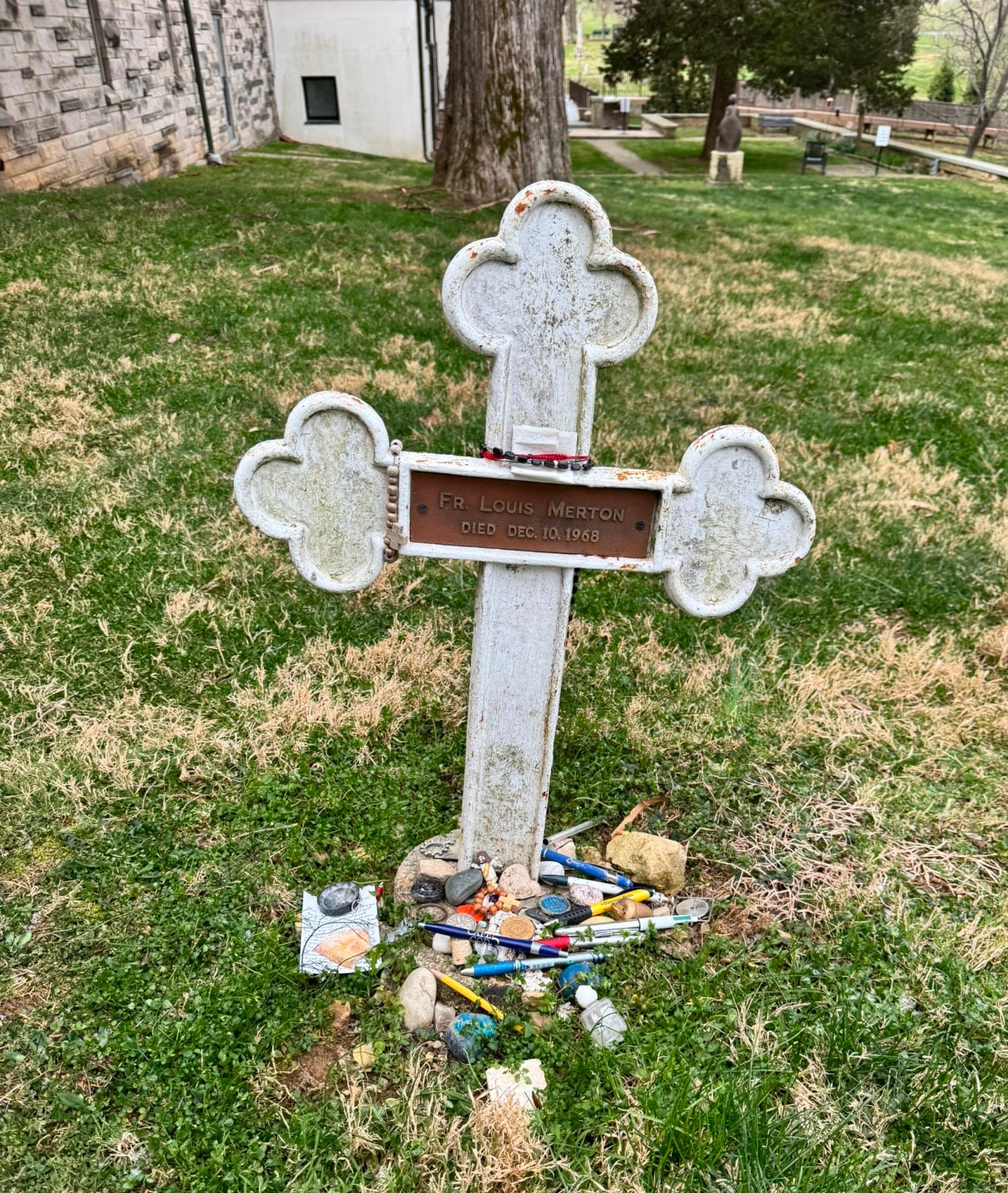
I took this photograph of Thomas Merton’s grave at the Abbey of Gethsemane on my visit there.
Finding Thomas Merton on the Campaign Trail.
Tuesdays with Merton works very nicely with a talk called “Finding Merton on the Campaign Trail,” since we have elections on Tuesdays in America.
But we are not going to spend time in the voting booth, unless you want to ask me about that in the question period. Instead, we start our time together tonight in bed, where this story begins.
The bed at the center of one of those anonymous hotel rooms in America’s great fleet: host to the traveling salesman and his samples, the middle manager checking on the regional office, and the daughter returning home whose mother wishes she’d just stay in the spare room.
Included also in this hotel menagerie are political reporters. That is how I spent the first 25 years of my career, crossing the country covering campaigns, which meant a lot of time in America’s hotel beds.
I covered some exciting times in American politics. On the 2000 campaign I lived for weeks on John McCain’s campaign bus. Then I covered Governor Bush, as a candidate and as president and then the Obama campaign which drew crowds of a size no one had ever seen before.
At some point when hotels started giving electric room keys, I brought them back for my oldest son. That stack is several feet high now.
Unlike the solitary traveler, during campaign years, reporters often move in packs-- following the candidate running for office.
After the day, which can include the same speech delivered in five different cities or states, you join with the other journalists at the hotel bar.
We would mimic and critique what we had witnessed that day, recount abuses from our bosses back at headquarters, and try out our punditry on one another over fresh drink orders.
When I covered my first two campaigns in 1996 and 2000 for Time magazine, I was at the bar every night. We stayed up late. We drank a lot. You could smoke indoors in those days and the whole business was very cinematic. From the lobby of the hotel, you could hear the blooming gales of laughter. We probably looked like a mix between a mead hall and a locker room for the least healthy sport ever played.
Republican strategist Mike Murphy, a top figure in several presidential campaigns, used to say campaigns were like war without bullets. Full of twists and turns, high emotion and energy, the stakes were very high but there were no actual casualties.
Occasionally some of the great journalists who had covered earlier campaigns-- Kennedy, Johnson, Carter -- would join us and we’d sit like grandchildren on the front porch asking Pa to tell us another story about what he did in the war.
For example, in late October 1976, during a campaign stop in Joliet, Illinois, President Ford and some of the regulars on “Air Force One,” decided they would play a joke on one of their colleagues a TV reporter who was a little picky about his hotel room. President Ford distracted him, while the other reporters put a goat in his hotel bathroom.
When the victim finally returned to his room and opened the bathroom door, he was greeted by the goat. The animal had not spent the time in quiet contemplation. He had, as goats do, made quite a mess of the bathroom. The press corps was huddled in the hallway, and Ford was reportedly waiting nearby (or checking in shortly after) to enjoy the fallout.
One of these nights, after we were only in the early innings of our standard extra-innings of drinking, one of these older correspondents got up and said he was going to bed. He may have mentioned something about age, commitments, calling his children or something.
I had none of these things.
I thought, what a bummer for him, to miss out on this big time we were having antiquing our livers and showing each other how clever we were in the Des Moines Marriott or Columbus, Hampton Inn or the Westin in Tampa Bay or whichever bar it was that we were assaulting!
But by about 2012 I was the one leaving the table, if I even went to the bar at all. I was a father and my wife and kids were at home. Being on the road was much more lonesome. The carnival revelry wasn’t as charming.
Something was also happening to political coverage that made being on the road feel less meaningful as a vocation.
If you’ve ever watched a political convention, you know that American politics has always been silly. At conventions, that silliness all focuses it all into a narrow space. They wear hats of extravagant shape and festoon themselves with buttons and every manner of red, white, and blue clothing.
It’s also important to remember that alcohol has been a frequent and useful inducement to political activity. In short, American politics is not always a high-minded affair.
But the silliness was not the entire diet. When I started, the pageantry and foolishness were often interrupted by a competition of ideas.
In my first campaign covering Republican nominee Bob Dole in 1996 he devoted an entire week to his plans for reforming social security. The speeches addressed the details of the system. Afterward, experts from the campaign briefed us in the gravel of the parking lot of the VFW hall where the speech had been given. They handed out actuarial tables.
The retirement system’s health was a national problem, and candidates for national office were expected to address national problems. They might be vain and power-hungry, but they channeled some of that ambition into arguments about the public good.
One of the great joys of being a political reporter is that you get to interview the country—farmers, small business owners, teachers, every kind of worker—and ask about their lives. It reminds you what campaigns are supposed to be about: improving the lives of the people whose votes are being sought.
Over time, campaigns moved away from the events of people’s daily lives. Instead of addressing big problems, candidates focused on finding—or inventing—grievances that could whip up supporters. Candidates made fewer arguments and more accusations.
The way the press covers campaigns makes this worse, because we go where the campaign goes.
We suffer from the Streetlight Effect. You know the old joke about the streetlight. A policeman comes upon a drunk on his hands and knees under a streetlight. What are you doing? He asks. Looking for my keys, says the drunk. Did you drop them here? No, I dropped them in the park, but the light here is better.
We cover campaigns where the light’s better.
During this restless period I did try to get away from the streetlight.
In preparing this speech I came across an article I wrote in 2015. It was dated March 17th. Today, in 2015.
As Merton says in one of his conferences when he’s explaining the path that led him to move to the solitary life in the hermitage: “When you look back you start to see signs.”
I had gone to Iowa to cover one of the innumerable candidate forums, but
instead of joining them in the hotel ballroom, I asked Catholic Charities in Des Moines to take me to the east side of the city— a place candidates drive through but where they never stop.
We went to a family center in a converted gas station where 500 households came through each day for rice packets, dry beans, whatever the donation happened to be— onions, bananas, tomatoes. The stories defied any single policy fix. Grandparents on fixed incomes showing up for an emergency box because they were suddenly raising grandchildren they hadn’t expected to raise.
We visited a clothing pantry where a man tried to pick out an outfit for a job interview, a mother found her daughter a winter coat.
We met with families at the shelter to talk about how hard it was to make the rent. There were close to 50 million poor people in America. No candidate was talking about their lives.
That article grew out of a feeling that the job I was doing had lost some of its meaning. As a journalist, my solution to that was to launch a quixotic campaign to improve presidential campaign coverage that I’ve been on ever since, which is a topic for another speech, or you can ask me in the question period.
In my personal life, I looked for ways to bring meaning out on the road with me. I couldn’t bring the kids. Anne couldn’t leave the kids. So, I’d pack my favorite coffee mug, my leather journal, a few totems to combat the sameness of the Courtyard Marriot.
…but that kind of thing only takes you so far in a hotel where the room is always different but the furniture seems the same.
Which brings us back to the bed.
If you’ve spent any time in hotels you know the nightly puzzle of finding the switch that actually turns off the bedside light. Once I’d solved that, I would end my day by pressing play on the audio of Thomas Merton on Contemplation, presented by Now You Know Media, in which Merton spoke to the novices at the Abbey of Gethsemani.
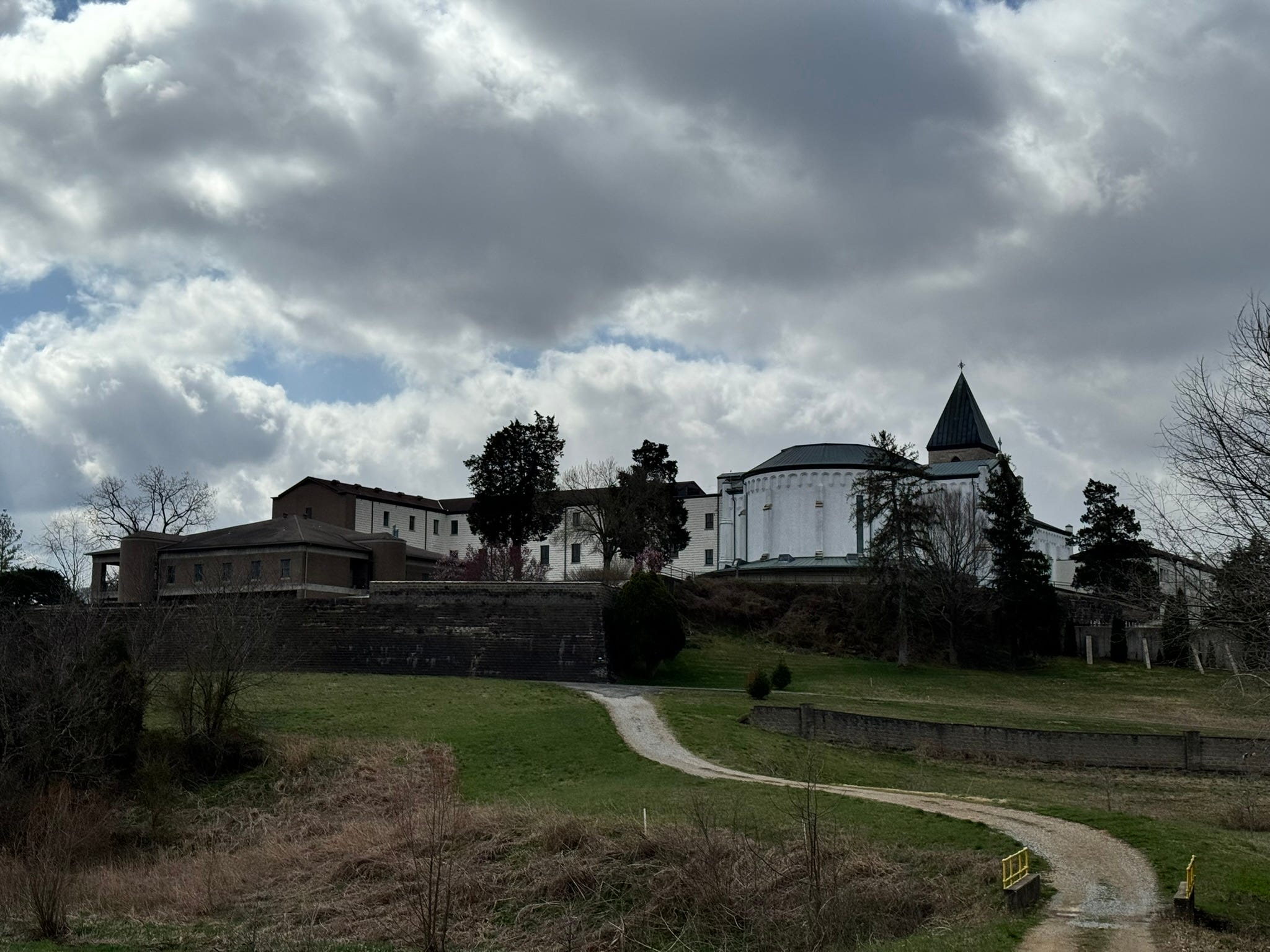
The Abbey of Gethsemani.
Why Merton? That answer also comes from the campaign trail. In 2008, Terry Moran, an ABC correspondent at the time, was reading The Seven Story Mountain. Whatever he said about it was strong enough to make me buy it after the election.
The period just after a campaign is a wobbly time. During the campaign, especially near Election Day, your life is programmed for you. You ride the bus, fly on the plane, stay in the campaign hotel, eat what’s put in front of you. This is called being in the bubble. Then the voting ends, and you have no schedule. You go home to a life that has continued without you. You feel a little lost.
It was in that stretch that I first read The Seven Story Mountain. Years later, I was feeling that same unmoored feeling but it wasn’t after the campaign, but during it.
But why another dose of Merton? A little background on my faith. I am what you might call a homemade Catholic. My mother was devout. Her mother more so — daily mass, Midwest Irish, the whole inheritance. I was baptized, had my first communion, went to CCD, played CYO basketball. But then my parents divorced when I was thirteen and I went to live with my father. I went to mass after that, but intermittently, and largely alone.
I give you this history so you understand what you’re looking at and the posture I brought to Merton. I’m like the knight who shows up at the jousting tournament wearing armor made from serving dishes and a stew pot for a helmet. Not exactly regulation.
So, Merton’s conferences were another piece of scrap metal I thought might be worth banging into place.
In my hotel cell, I listened to him talk to the Novices about ‘peaceful sweet rest in the cell.’ He was trying to get the novices to appreciate their solitude; I was trying to find a way to survive mine.
I loved hearing him mumble through trying to remember the names of the brothers in formation sitting in front of him and hearing him tell jokes.
The surprise you can hear in his voice as he explains The concept of free association to the novices and then finds that he’s suddenly free-associating about beer.
“Well, it’s a hot day,” he says.
This might sound like very odd behavior on my part. My wife certainly thinks it is, which is why I listen to these conferences when I’m on the road and not when she’s also trying to fall asleep. One reason this is strange behavior is that the content centers around the specific challenges of being a monk. I have never considered being a monk, though as I am an introvert I certainly find the appeal.
What drew me, and still does, was the sound of a teacher who hadn’t stopped learning. Merton wasn’t sandblasting the novices with doctrine. He was inviting them along on the same journey he was still taking — puzzling out loud, doubling back, working a different angle, making discoveries in real time. His tone shifted from firm, to doubting, to delighted, sometimes within the same sentence.
If you know what it sounds like to hear someone speak while smiling, that quality is present throughout.
Merton was seeking to convey understanding, not just knowledge. There is a vital distinction: Knowledge is memorizing the items in a recipe. Understanding is being able to improvise a dish from scratch.
Knowledge is fragile; understanding is supple. If you are armed with mere knowledge, a contradiction can sink you. If the recipe calls for buttermilk and you don’t have any in the fridge, you’re stuck. No pancakes. But if you have understanding, you know why the buttermilk is there—for the acidity—and you can reach for the lemon juice or vinegar to replicate the effect.
You get a sense of Merton’s humility in the way he referred to his own conferences “giving this junk out all the time, he called it. He also said that it was a grace because it made him make sure that he was practicing what he was preaching.
I have now listened to these conferences so many times that I know all their little nooks. The way Merton punctuates certain sentences with the word “see.” When he does it—”See”—and why he does it—”See.”
Or, the mild flutter in his voice as he announces that he’s going off to live alone in the hermitage. He’s a little nervous.
Or, when he describes the toil of picking strawberries in silence as a “fruitful penance,” each time, I want him to acknowledge that he has made an unintentional pun.
Children ask to be read the same story again and again because the familiarity comforts them. I guess this was my version of that.
This familiarity does not travel beyond my brain. When I occasionally tell one of my children, “You’re a real wise desert father,” repeating a line from one of the conferences, they look at me and think I’ve gone batty.
Though this is also their default view of me.
If you leave aside recorded music, I don’t think there is a recorded voice I have listened to more.
It wasn’t just the information I was taking in. Much of the content confused me at first. What mattered was that Merton modeled a way of being in relation to a question. Most of us treat not-knowing as a private failure. A great teacher shows you that, with certain questions—God, mortality, the interior life—not-knowing is the correct response. Merton in one of these conferences says you must be “tremendously sifted by doubt,” and he sounds almost delighted by it.
Loneliness at its core isn’t the absence of people — In my case I was surrounded by colleagues. They were all down at the bar. Loneliness is the feeling that no one is accompanying you in the particular place where you find yourself in a given moment. Merton felt like he was in that place.
There’s also something specifically powerful about a recorded voice you return to. It’s different from reading. The voice doesn’t change. It’s patient in a way no live person can sustain. It’s there at the specific hour you need it without requiring anything from you.
I have a simple test for myself: at any given moment, can I say, “I am being the person I want to be right now?” Merton’s language of humility, love, charity, and grace drew me because it illuminated the few moments in my life when I had actually felt that way. Not perfect. Often making a mess of things. But pointed in the right direction. Merton would call that becoming your true self.
Merton’s conferences are full of metaphors— for the soul at prayer, he uses three different ones— so maybe that’s why I have different metaphors for my experience with him.
He’s walking across the fields on some path I know I want to walk myself. The path where I am the person I want to be. I just need to make my way over to him. Sometimes this requires a day long walk. That’s rare. Usually the distance is longer. My flaws drive me away and it feels like he’s a dot in the distance, in danger, maybe, of disappearing.
Merton’s unexpected accompaniment in an unexpected place of my life on the road made him feel close at hand. It turns out, he was closer at hand than I even realized.
He was hiding out in our home.
We have a lot of books. I’ve written about presidential history, had a podcast about the presidency. Used books are quite inexpensive.
Because we have so many books, it’s sometimes the case that I’ll see a cover for years but not really know much about the book. For the longest time a white one sat in the religious section next to The Parables of Peanuts and We Have Come to Seek Jesus. I assumed it had something to do with my wife’s Presbyterian education, or maybe it was a book she got from teaching Sunday School.
But one day— I can’t be more specific because I don’t have Merton-like epiphanies with dates attached— I realized that the white book with the out-of-focus picture of some kind of wheat or something on the cover had been written by Thomas Merton. We had a copy of New Seeds of Contemplation embedded in our house. Like a spy!
My unfamiliarity with my own shelves runs even deeper than that. In preparing for this visit I was wondering why I had never read No Man is an Island. So many people talk about it. Then, a week ago my wife asked if I needed this Merton book she’d found mis-shelved in the house. It was underlined, notes in the margin. The book: No Man is an Island.
Man cannot find himself in himself alone, Merton writes in that book, and in my case man isn’t going to find himself at all if he can’t find the book.
Sometimes the pot on the knight’s head falls over his eyes.
But while I don’t have specific locations for my revelations, I do know when I started following that thread of Merton from the conferences into his writings.
I write in my books. On the front page I write my name, the date I started, and sometimes a note. In New Seeds of Contemplation it reads: “Read by JFD during his Merton obsession of 2016 to 2017.” Then, a year later: “this book has been consistently powerful for me.” And beneath that, a line from Merton in one of the conferences: “Don’t be afraid to pick up a book in meditation.” The book had moved from object to companion.
On the next page, before we even get into the book, I wrote this. There is no date:
“This book sat for years on my shelf. Anne had purchased it somewhere. It was like the one ring, which sat for so long at the bottom of the river. Such a powerful thing that was about to play such a role, but which sat undetected and therefore seemingly powerless…Then, once it was found, it rose and took on a tremendous, powerful aspect. The ring wants to be found, but in this case the goodness in the world also wants to be found. This book sat dormant, out of the way, simple and pleasing, ready for its part when the time came.”
Unlike the ring, which makes its user invisible, New Seeds, like much of Merton’s work has been a tool to help me see.
To see myself more clearly than the cares of the day allow. To see other people as Merton saw the strangers on the corner of Fourth and Walnut — lit from within.
So, every morning that I can over the last decade or so I have started my day reading Merton. Merton isn’t my only spiritual reading, but he’s the main one.
Another note in the margin from New Seeds: “In the morning I go to Merton. I locate myself there. It is when I seek God. Seek to close the gap.”
That, I suppose, is the beginning of that Merton in the field metaphor. The gap I am trying to close between myself and Merton that opens up by doubt, ego, confusion, the cares of this world.
What does it mean to close the gap while doing this reading?
Imagine that your job is to cover American politics, a world that encourages snap judgments and trains people to see opponents not just as mistaken, but as evil. In that atmosphere, it is nourishing to read this from New Seeds:
p.77
“I cannot treat other men as men unless I have compassion for them. I must have at least enough compassion to realize that when they suffer they feel somewhat as I do when I suffer. And if for some reason I do not spontaneously feel this kind of sympathy for others, then it is God’s will that I do what I can to learn how…contemplation is out of the question for anyone who does not try to cultivate compassion for other men.”
Reading Merton re-orients me, but while it might help me see him walking way across the field, I also become aware of the absolutely yawning chasms I have to cross, because this comfortable self-creation which I settle into in my favorite chair in my office at the top of our brownstone, that routine might very well be a total sham:
“The deep secrecy of my own being is often hidden from me by my own estimate of what I am.” (No Man is an Island, p. 125-126)
“Every one of us is shadowed by an illusory person: a false self... We are not very good at recognizing illusions, least of all the ones we cherish about ourselves.” (New Seeds)
This self-taught Catholicism has very difficult homework. But I have come to the view that trying is the thing. Maybe that comes from Merton’s famous prayer: I have no idea what I’m doing, but I believe the desire to please you does in fact please you.
What I seek in those morning readings is what Merton called being “simplified out under the gaze of God.” He says some truths are “inaccessible to the understanding.” I take that to mean there are things too large to be mastered by analysis alone. They have to be received.
And so now we’ve got another metaphor:
In these morning readings, I started to think of Merton sitting at one end of a rowboat rowing out into some countryside full of wonders. There is no noisy outboard motor, just the regular gentle splashes of the oars. He doesn’t say anything, or even give me any of those signs they use to communicate at the Abbey. He is taking me out in the boat but the fruit of the trip is up to me and what I take away from what I experience. I might look to him from time to time but his wordless response reminds me that I should be looking everywhere else but him. We should look in the direction he is looking, at the landscape he has put before us, but from there the conclusions are to be our own.
Now I know this is a real metaphor pile-up in which in the second one I am in proximity to Merton but in the first one it is the lack of proximity that I’m trying to convey. But if Merton and the novices can describe the soul at prayer as both like a feather and a millwheel, I’m going to hope that while my metaphors would not get past the editorial board at the ecclesiastical review, they’ll be allowed as the pleasant clang of my rough armor.
While we’re hitting the metaphor piñata, I also like Martin Laird’s sailing metaphor of the union between human effort and divine grace. The sailor does not produce the wind that moves the boat, yet without the sailing skills that harness the wind, the boat will move aimlessly.
The best example of this I can offer was not something that happened to me, but my friend, the Jesuit priest, Father Jim Martin, who I mentioned earlier. In his recent book, Father Martin talks about how a documentary on Merton convinced him to join the priesthood. For him, that was his fourth and Walnut moment. But later in the book, he talks about his early days entering the priesthood. A father asks him to go off in contemplation to think about Jesus and after some fits and starts a word just lands in his brain, “friend.” In contemplation, a single word landed in him: “friend.”
The art historian Ernst Gombrich coined a term he calls the “beholder’s share,” which refers to the role the viewer has when looking at art.
You bring your experience, your attention, your need, and the art draws something out of you that straight rational thought couldn’t reach. The painting doesn’t change. You do. A work of art is not simply the thing on the wall, but what happens between the thing on the wall and the person standing in front of it.
Our Lord’s parables do this. Jesus doesn’t explain — he invites you to work it out, because the working out is the thing. The revelation arrives through engagement, not assertion.
“Art is not an end in itself,” Merton writes. “It introduces the soul into a higher spiritual order, which it expresses and in some sense explains.”
Contemplation works the same way for me, I think. You bring yourself to it — your doubt, your distraction, your longing — and something comes back that you didn’t manufacture. “An act of pure attention, if you are capable of it, will bring its own answer,” D.H. Lawrence wrote.
This alchemy relies on hope.
Pay attention. Arrive with hope that something will meet you there. That hope is not passive. It is the necessary act. The precondition for everything.
“By hope,” Merton wrote, “the abstract and impersonal become intimate conviction. What I believe in faith, I possess and make my own by hope.”
Merton distinguishes between two modes of holding a belief. Faith is assent — you accept something as true, but it stays at a remove, like knowing a fact about someone you’ve never met. Real, but not yet landed.
Hope closes that distance. It’s the move from “I accept this” to “this is mine.” Faith is knowing there is water in the well. Hope is reaching for the glass.
And he isn’t talking about sunny certainty. Hope, by definition, involves things not yet fully in hand. But making it yours is not a passive act. It isn’t a rest; it’s a struggle. A struggle against doubt.
We often think of doubt as the enemy of faith, but for Merton—and for his novice Paul Quenon, whom I was blessed to meet today—doubt was part of the investment.
“He struggled with doubts continually,” Quenon writes of Merton, “but had integrated them as an essential in the true life of faith. In his view, answers were beside the point. The real issue was the struggle with God. Faith, he said, is like Jacob wrestling in the night with something he cannot name. Faith means to be that much engaged with God. Doubt is part of the faith, not something to be excluded. Without doubt, there may be no real engagement at all, just a placid piety that masks as faith but is simply an evasion. Doubt is sometimes the fruit of love, a love that seems thwarted.”
That is the paradox of hope. We usually associate it with a light, airy longing for what isn’t guaranteed. But here, the reaching is what creates the intimacy. You don’t wrestle with a ghost; you wrestle with something that has weight and presence.
Hope-- real hope in the world-- requires courage. “Laziness and cowardice put our own present comfort before the love of God. They fear the uncertainty of the future because they place no trust in God.” ( Thoughts in solitude, p.22)
I came across this idea of courageous hope in my day job several years ago. I was interviewing the late congressman and civil rights icon John Lewis. We were at the lunch counter exhibit at the National African American Museum. A replica of the lunch counters where he was not allowed as a black American and where he and his friends were spat on, denied service in a country dedicated to human liberty.
Photographs were scrolling across the wall. The famous one of Lewis and Dr. King appeared where Lewis is wearing a backpack.
In it he’d put an orange, a toothbrush, overnight provisions...
Police in gas masks with clubs were preparing to beat the nonviolent marchers if they kept walking in support of their right to vote. Lewis knew he’d spend the night in jail. He’d need those supplies.
What gave him the courage to stand there in the face of a beating that would ultimately crack his skull for a cause that showed no chance of becoming real? I think the answer provides some guidance for our times.
In the backpack Lewis put two books, more than just overnight jail reading; they identified the source of that courage.
The first was Seven Story Mountain. Lewis shared Merton’s Christian faith in non-violence and love even for his enemies. (I’d have loved to have known if the Fourth and Walnut revelation about the humanity of God shining through could extend all the way to Bull Connor.)
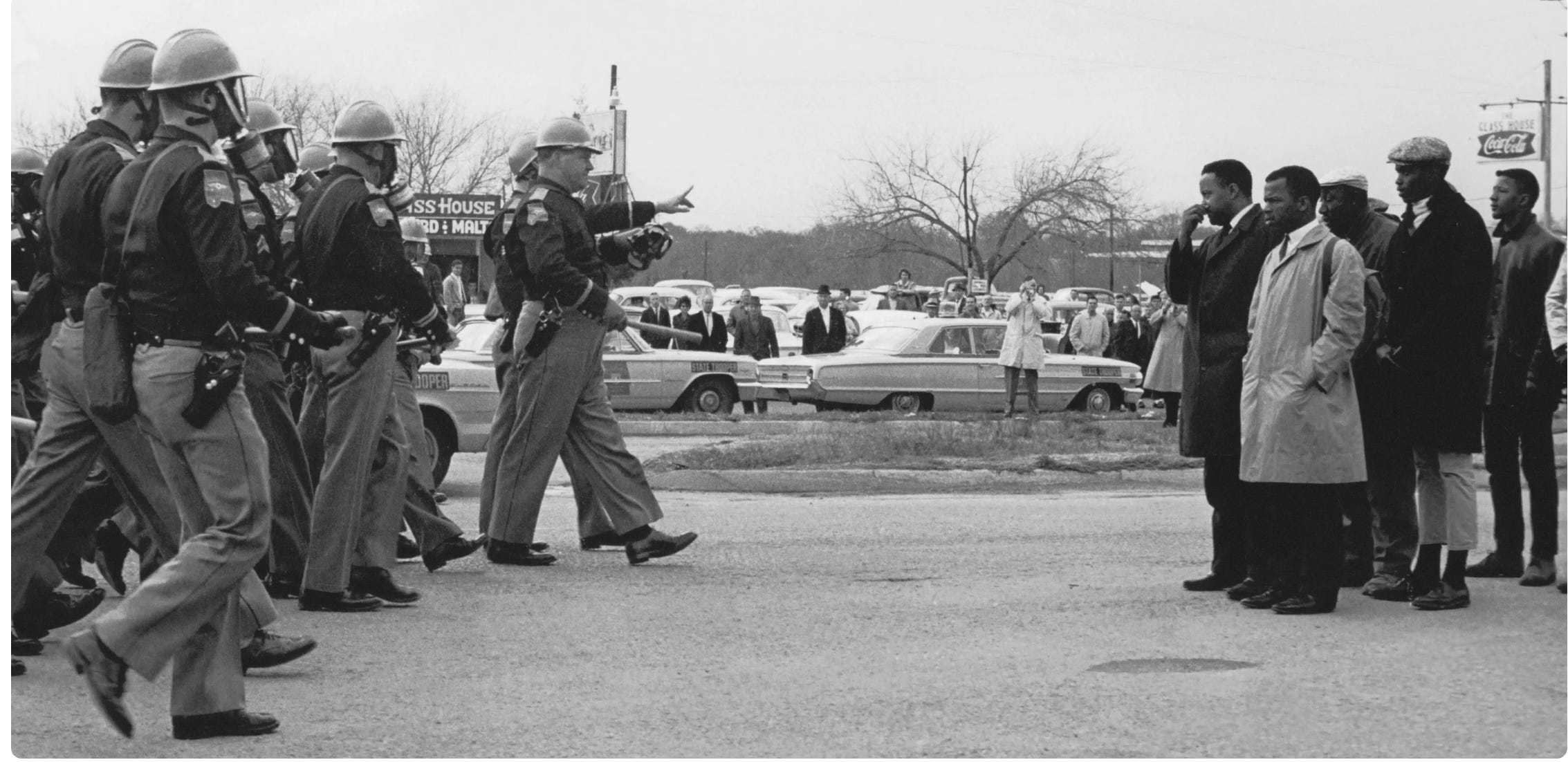
For Lewis, hope wasn’t abstract—it was personal, lived conviction, it didn’t stay in the church or in prayers at night, but by living it in the world-- through personal sacrifice and courage-- he gave it life. It sustained him in the face of that assault.
That hope leaves a residue for others. For us. The clue to it is found in the other book that Lewis was carrying. The history book The American Political Tradition, by Richard Hofstadter. It starts with a quote from John Dos Passos: “In times of change and danger when there is a quicksand of fear under men’s reasoning, a sense of continuity with generations gone before can stretch like a lifeline across the scary present.”
That’s the role Lewis’ hope plays now for anyone trying to gain its nourishment in a turbulent world. That day on the bridge. What would come to be known as Bloody Sunday was a day of despair. In the moment the balance of evidence would have suggested that despair was to be the permanent state of things. But a faith in hope and history beat that despair and left a legacy of courage and a model for time.
Lewis spoke at the march on Washington and before he died he would see the first African American president inaugurated on the other end of the mall. The museum where I interviewed him — which Lewis had worked for decades to make a reality — stands at the midway point of that same Mall.
We can carry that same backpack Lewis carried. We can nourish off of that same hope. And while the future is still frightening, we do have proof— a lifeline— of what hope was able to inspire from the past.
It was with this idea of hope that I read Jon Meacham’s new collection of documents from American History called American Struggle. First of all that title is important. American history is a struggle. And to make it through struggle you need hope. His primary example of that hope is Frederick Douglass.
On March 6, 1857, Chief Justice Roger Taney issued the verdict in the case of Dred Scott, an enslaved man suing for his liberty. Scott had no standing in the American order, the court ruled — no standing other than the fact of his enslavement. Black people were not protected by the Declaration of Independence’s assertion of innate human equality. They could not be citizens. And then Taney went further: black people had, for more than a century, been regarded as beings of an inferior order, so far inferior that they had no rights which the white man was bound to respect. The court didn’t just rule against Scott. It ruled that the founding promise had never included him. Had never intended to.
How did Douglass, who had been enslaved but won his freedom, respond? “You will readily ask me how I am affected by this devilish decision—this judicial incarnation of wolfishness? My answer is, and no thanks to the slaveholding wing of the Supreme Court, my hopes were never brighter than now.”
My hopes were never brighter…
Douglass’ famous speech known as “What to a slave is your Fourth of July,” which vilifies the hypocrisy of an America founded on liberty and built on slavery, nevertheless contains the word hope more than six times.
“Oppression, organized as ours is, will appear invincible up to the very hour of its fall,” wrote Douglass.
Again, that is durable hope in action, giving sustenance at the greatest moment of doubt, the greatest moment of peril. The Christian writer G.K. Chesterton says “Hope is the power of being cheerful in circumstances which we know to be desperate.”
“Hope means hoping when things are hopeless, or it is no virtue at all. As long as matters are really hopeful, hope is mere flattery or platitude; it is only when everything is hopeless that hope begins to be a strength.”
Lewis and Douglass show what hope looks like in the world I cover. I also experienced the personal embodiment of the community Merton demands.
Merton kept appearing where I didn’t expect him. In a hotel cell. On a bookshelf. And then he arrived in the form of a person, who I discovered in -- of all places-- social media, a location where we might go if we wanted to learn all of the opposite lessons.
But a tree can grow in Brooklyn.
Grace can show up even in in that cramped and noisy space that social media has become — and for me it did in the form of Gregory Hillis, who many of you in this audience know because he was a professor at Bellarmine.
His thoughts about Merton were a tonic in the middle of the day, and they drew me in.
We started a correspondence. When I told him about my bedtime listening habit, he secreted me recordings of conferences that had never been made public. (I’m not strictly speaking sure that he was allowed to do that but I was grateful). A photograph he took from Merton’s desk at the hermitage became the screen saver on my second monitor. When I would sit down to write, I’d set that screen on the view Merton would have looked out on.
Greg came to New York and we had lunch — Mexican food, down the street from St. Paul the Apostle, where I attend mass. We talked about faith, family, baseball, the role Merton played in our lives. We shared the same taste in music. He described his sons and his wife with a love and energy that made you want to be in the room with all of them. We made plans for me to come visit him. He offered to be my guide at the Abbey, but since he transferred to Emory before that could happen, I planned to visit him in Georgia. And perhaps bring my wheelbarrow full of armor to his classroom.
Then he was diagnosed with cancer which made the visit all the more urgent. The day I was to fly down to visit he was just too sick, so we postponed. A few weeks later, I texted to reschedule, his wife Kim wrote back to tell me Greg had died.
That was two years ago and I’m pretty sure Greg’s only about halfway through his interview with Merton — the one that started just after he went to join him. On the other hand, perhaps all was revealed in an instant, and so they’re just watching baseball.
What started as an abstract voice, developed through meditation then connected me to another human soul. I found Merton in solitude, but Merton led me back to community both in knowing Greg but also in learning from his study of Merton and the idea of dialogue-- Merton’s belief that love and charity aren’t something you hold on to and pet in the cloister of your own solitude. There is an obligation to be out in the world, to act and see with the vision of love that overcame him on
Fourth and Walnut.
My visit to Gethsemane today with Paul put earth under words I first heard in a hotel room. I stood in the place where those recordings were made. I stood before Merton’s grave.
That journey — from a darkened room in the Des Moines Marriott to the Abbey where he lived and is buried — would seem like a journey to find Thomas Merton. But I think, as may be true for many of you, you could reverse the trail of that campaign.
We seek him because he has already found us.
Thank you for reminding me of beauty in these times, where I struggle alone.
It's been ages since I once half-heartedly read The Seven Storey Mountain – skimmed is likely a better term. This made it clear that I ought to give it another go now that I've collected just enough wisdom to know I don't really know much. Thank you for this reminder of his work.
My reciprocal recommendation is The Intellectual Life by the Dominican A. G. Sertillanges - a beautiful reflection on how to think and work purposefully (though his views on the role of the wife in that endeavor are a bit out of fashion a century later!)