


I will tweak this page so keep checking back. (Poll figures will change. Exit poll data will get another teeth-cleaning, etc.) If you are a subscriber and are receiving this by email keep checking back with johndickerson.com for updates. Last update 11/6/26 at 10:00 am.
Fifth Avenue Rule Broken: In 2016, Donald Trump said he could stand in the middle of Fifth Avenue and shoot somebody and not lose any of his voters. He was talking about his base, but in office, the line described his way of governing: do the unheard-of and dare anyone to stop you. He pardoned the people convicted of crimes in the January 6 attack on the Capitol. He tore down the East Wing of the White House. He accepted a jet worth roughly $400 million from Qatar to use as Air Force One, fired the commissioner of the Bureau of Labor Statistics after a bad jobs report, and took the country to war with Iran without asking Congress. Days before the election, he said he would pardon his aides and allies in advance if Democrats won: “I’d do it. I did it for J6.” The courts couldn’t keep up, and sometimes didn’t try; the Supreme Court gave him more power over federal agencies. His party didn’t mind. On Tuesday, the voters responded. 71 percent of voters said Congress should do more to check President Trump, according to the national midterm exit poll reported on election night.
Lowest approval rating: In CBS News’s early exit poll, Trump’s approval stood at 38 percent, on track to be the lowest recorded for a president in a midterm exit poll. It was below Trump’s own 2018 number and below George W. Bush’s in 2006.
UPDATE: Karl Rove wrote after the election: “Mr. Trump can’t escape blame so easily. He and his policies and candidate choices burned the Republican Party to the ground.”
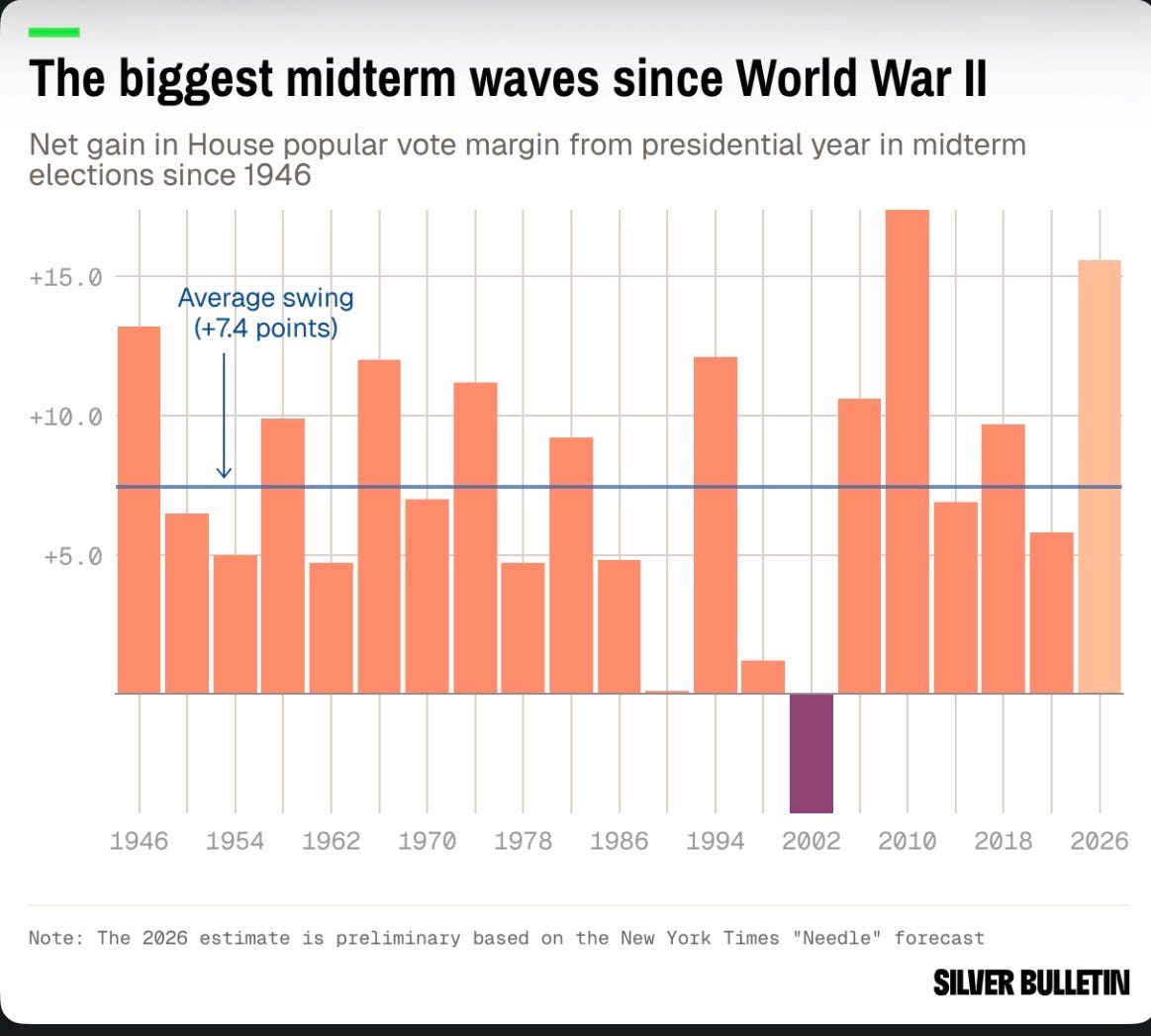
Size of the Win: Democrats are on track to win the House vote by about 13 to 14 points, the biggest margin since 1974. By Thursday, Democrats had secured 54 Senate seats, with Alaska and Mississippi still outstanding. They didn’t just win the battlegrounds; they won deep in Trump country. In South Carolina, which Trump carried by about 18 points in 2024, Annie Andrews beat Sen. Darline Graham.
In Kansas, a Trump +16 state, Adam Hamilton won. In Seward County, Kansas, home to one of the country’s largest beef processing plants, Trump won by 39 points in 2024. Hamilton was ahead by 13 in the returns Reuters reported, a 52-point swing. In Texas’s 15th District, which Trump would have carried by nearly 18 points on the new lines, Bobby Pulido beat Rep. Monica De La Cruz 62 percent to 38, a swing of about 42 points. Across the swing districts, Democrats won by an average of about 13 points, by a New York Times estimate.
Distant Galaxies: The Trump loss reached places Republicans had drawn to keep. Three races to watch in the Wednesday morning returns:
Tennessee’s 4th, redrawn by Republicans to be Trump +24: Democrat Victoria Broderick led Rep. Scott DesJarlais by fewer than 300 votes in unofficial state returns. AP had yet to call it as of 5 a.m. Eastern.
Texas’s 9th, drawn to be Trump +20: Democrat Leticia Gutierrez faced Republican Alex Mealer for the seat held by Democrat Al Green before the redraw.
Mississippi Senate, Trump +23 in 2024: Scott Colom led Sen. Cindy Hyde-Smith by 3,182 votes in Decision Desk HQ’s 1:15 a.m. Eastern tally, with more than 95 percent of the expected vote in.
The Swing Was Everywhere: Republicans lost ground in 99 percent of the roughly 2,200 counties with substantially completed returns examined by Reuters and USA Today on Wednesday morning. Across those counties, the Republican vote share averaged eight percentage points below Trump's 2024 share. The decline extended across cities, suburbs, wealthy communities and poorer counties.
The Election Held. Courts blocked several administration efforts to intervene before Election Day. In California, they blocked a last-minute attempt to set aside ballots cast by voters the administration suspected were noncitizens. In Alaska, the Republican-led state government opposed a Justice Department effort to delay certification of the Senate race. A federal judge dismissed the suit, and Republican Sen. Dan Sullivan said he would accept the result even if he lost. Across the country, election workers dealt with the usual problems, but things didn’t get out of hand.
Bigger in Texas: The term “blowout” has a long history in Texas. Drillers can bore for months with nothing to show for it. Then the bit hits pressure, the well blows out, and oil gushes. They call it the well “coming in.” The most famous came in near Beaumont on Jan. 10, 1901: the Lucas gusher at Spindletop shot oil more than 100 feet in the air for nine days. Democrats have been drilling in Texas Senate races since 1988 with nothing to show for it. On Tuesday the well came in. James Talarico beat Ken Paxton, Donald Trump’s handpicked candidate, by about 10 points in Wednesday morning returns in a state Trump carried by 14, becoming the first Democrat to win a Texas Senate seat since Lloyd Bentsen. Gina Hinojosa won the governor’s race by about 16 points, 57 percent to 41, becoming the first Latina elected governor of Texas and the first Democrat elected to the office since Ann Richards, who lost to George W. Bush in 1994. The Democratic sweep in Texas reached even the Railroad Commission, the state agency that regulates oil and gas production. Democrat Jon Rosenthal defeated Republican Bo French, becoming the first Democrat elected to the three-member commission in more than 30 years.
Bad Picks: Some of the biggest losses of the night were candidates Donald Trump picked by hand. In Texas, Trump backed Paxton over the sitting Republican senator, John Cornyn, in the primary. Paxton then lost to Talarico. In North Carolina, Michael Whatley, whom Trump had already installed as Republican National Committee chairman and then endorsed for Senate when Thom Tillis retired, lost to Roy Cooper by about 19 points. The Republican charged with keeping the House majority lost his own seat. NBC projected that Richard Hudson, chairman of the National Republican Congressional Committee, fell to Democrat Richard Ojeda in North Carolina’s 9th District.
Faith in Office: Adam Hamilton, a United Methodist minister, won the Kansas Senate seat. He founded and still leads the Church of the Resurrection in the Kansas City area, the largest United Methodist church in the country, with about 25,000 members across nine locations, and he plans to keep preaching there while he serves in the Senate. In Texas, James Talarico, a former public-school teacher and Presbyterian seminarian, won. They join Sen. Raphael Warnock, senior pastor of Atlanta’s Ebenezer Baptist Church, which gives the Democratic caucus three senators who have preached or trained for the pulpit. On the same night, Michigan elected Abdul El-Sayed, who will become the first Muslim to serve in the U.S. Senate.
Democratic Governors: Democrats flipped five (Georgia, Iowa, Nevada, Ohio, Texas). Democrats will hold a majority of governorships for the first time in 16 years. Nine of the ten most populous states will have Democratic governors; Florida is the only exception. In Georgia, Keisha Lance Bottoms became the first Black woman elected governor in the United States.
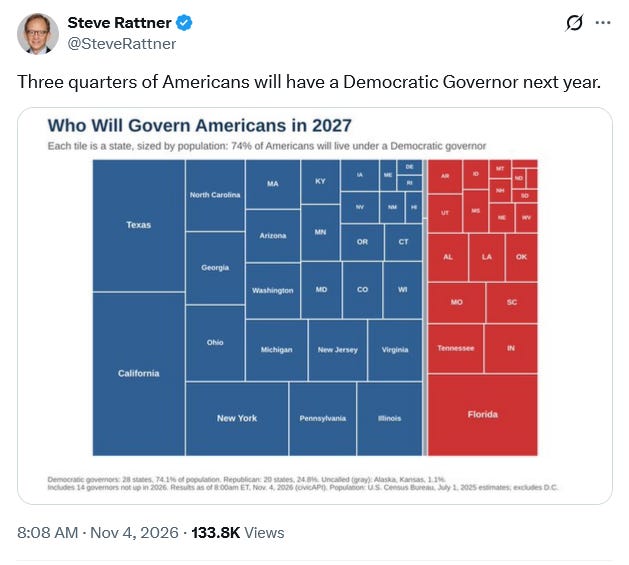
Battleground Governors: Democrats now hold the governorships in all seven presidential battleground states. They flipped Georgia and Nevada, held Arizona, Michigan, Pennsylvania and Wisconsin, and already hold North Carolina.
Legislatures: Democrats flipped the Wisconsin Senate and the North Carolina House. Democrats captured both legislative chambers in Michigan, Minnesota, Pennsylvania and Wisconsin, giving them full control of state government in all four. They also broke Republican trifectas in Georgia, Iowa, Ohio and Texas. Democrats were positioned to capture one legislative chamber in both Georgia and Texas.
Democrats also defeated incumbent Republican secretaries of state in Georgia, Indiana and Ohio, giving them control of offices responsible for overseeing elections and certifying results.
The Maps Backfired. Trump asked Texas Republicans to redraw their map to pick up five House seats. The plan bet that Latino voters would stick with him. They didn’t. Cuellar and Gonzalez held seats redrawn so Trump would have carried them by 10 points, and Pulido ousted Rep. Monica De La Cruz by 23 points in a district Trump carried by 18. Republicans may end up with fewer Texas seats than they started with.
Reuters reported Thursday that Democrats were leading in 12 of the 15 House districts Republicans had targeted through redistricting. The effort designed to protect and expand the Republican majority had instead endangered Republican incumbents. The push also fell short in Florida, where Democrats won three of four targeted seats Trump had carried by 9 to 11 points, and in Alabama, where Rep. Shomari Figures won by 8 in a seat Trump carried by 14. Missouri voters rejected their state’s map in a referendum, sparing Rep. Emanuel Cleaver, and California’s retaliatory redraw flipped at least three Republican seats, perhaps five.
Latino Districts: Texas districts that are more than 90 percent Hispanic swung 24 points toward Democrats. In the national AP Voter Poll, about 6 in 10 Hispanic voters backed Democrats for the House and about a third backed Republicans. Roughly 4 in 10 said they had voted for Trump in 2024.
Texas districts that are more than 90 percent Hispanic swung 24 points toward Democrats. In the national AP Voter Poll, about 6 in 10 Hispanic voters backed Democrats for the House and about a third backed Republicans. Roughly 4 in 10 said they had voted for Trump in 2024.
The Associated Press reported Friday that Talarico won roughly seven in ten Hispanic voters in the Texas Senate race, compared with approximately three in ten for Paxton. (The same electorate had been much more evenly divided between Trump and Harris in 2024.) Among Texas Hispanic voters under 65, AP found swings of roughly 20 percentage points toward Talarico.
Reuters found that Republicans lost an average of 14 percentage points of vote share compared with Trump in 2024 across 64 majority-Hispanic counties with Senate races and substantially completed counts. In Hidalgo County, Texas, the Republican share fell about 25 points.
Democrats won every congressional district touching the U.S.-Mexico border, something they had not accomplished since 2008.
Reuters reported a separate exit-poll comparison that put Republican support at about one-third this year, down from 46 percent for Trump in 2024. In seats Trump carried two years ago or would have carried on the new lines:
Texas’s 15th, Trump +18: Bobby Pulido beat Rep. Monica De La Cruz, 62 to 38.
Texas’s 28th, Trump +10: Rep. Henry Cuellar won 66 to 30.
Texas’s 34th, Trump +10: Rep. Vicente Gonzalez won 56 to 40.
Texas’s 35th, Trump +10.5: Democrat Johnny Garcia won the redrawn seat.
Texas’s 23rd: Katy Padilla Stout beat gun-rights activist Brandon Herrera in an open seat.
Young Voters: In 2024, voters under 30 were roughly evenly divided between Trump and Harris. In 2026, about seven in ten supported Democrats in House races and three in ten supported Republicans, according to the AP Voter Poll. But young voters accounted for only about one in ten voters nationally. Their sharp shift mattered, but their relatively small share of the electorate limited its effect. About half said they were angry about the country's direction, compared with roughly a third of voters 65 and older. Six in ten said opposition to Trump motivated their House vote.
Black Voters: Trump made significant inroads with Black men in 2024, winning roughly a quarter of their votes, according to AP VoteCast. Those gains largely disappeared. In the 2026 AP Voter Poll, only about one in ten Black men supported Republican House candidates. About nine in ten Black voters overall backed Democrats, compared with approximately eight in ten who voted for Harris in 2024. In Georgia, about nine in ten Black men supported Keisha Lance Bottoms for governor, compared with roughly three-quarters who supported Harris two years earlier.
Split Ticket Voting: Twelve states now have at least one senator from the party that lost the state in the last presidential election, up from seven. Tuesday added North Carolina, Texas, Ohio, Iowa, Kansas and South Carolina, and Maine dropped off the list with Susan Collins’s loss. Mississippi and Alaska could make it 14. That gives some senators a reason to listen across party lines. To win again, they’ll need to keep voters who were willing to give the other party the White House. The swings were enormous. Cooper won North Carolina by about 19.5 points, a 22-point swing from Trump’s 3-point win there. In the Wednesday morning returns, the swing in Texas was about 24 points, from Trump by 14 to Talarico by about 10. In the House, AP counted more than two dozen Democratic flips, including districts Trump carried by double digits in 2024.
There is a bottom: There is a bottom, and Ohio gubernatorial candidate Vivek Ramaswamy found it. His ad featured Amy Acton’s long-estranged mother calling her daughter a liar. Court records show the mother’s late husband was charged with raping Acton when she was a child; he pleaded not guilty, and the case never went to trial. Gov. Mike DeWine, a Republican, said “It’s wrong to run this ad” and asked that it come down. Sen. Jon Husted said he wouldn’t have run it. Ramaswamy kept it running. President Trump said he told him to “keep it up,” calling it “hitting pay dirt,” and JD Vance praised Ramaswamy’s “audacity.” There is no solvent strong enough.
UPDATE: Newt Gingrich listed the ad in his post-election evisceration of Vance when cataloging the Vice President’s failure: “…his defense of Vivek Ramaswamy's horrible, inhumane ad…”
UPDATE: Gov. Ron DeSantis (R-FL) slammed Vivek Ramaswamy, who was the Ohio Republican gubernatorial candidate, saying he was never in tune with voters’ interests. “How bad did they beat Vivek like a drum?” DeSantis said Wednesday on The Sage Steele Show. “Now, part of that was Vivek, quite frankly. I don’t know why they would have pushed him to be the candidate there.”
JD Vance: The vice president joked at a Paxton rally in Tyler, Texas, “I love you, too, sir. In a totally platonic way, to be clear. I’m the vice president, not James Talarico,” praised Ramaswamy’s “audacity” for running the ad about Acton’s mother, and said Republicans who objected to it should stop “whining.” In Michigan, he told voters to “punish” Abdul El-Sayed, who is about to become the first Muslim U.S. senator, and called him “very, very evil.” And when a young conservative at a Fox News town hall in Fort Worth asked how her generation could start families with the average home costing more than $415,000, he turned to a joke about Sen. Jon Husted’s backside. El-Sayed won by eight points. Vance will now preside over the Senate where he sits.
2020: Donald Trump lost the 2020 election. Nevertheless, his hold on the party has been so strong that few dared question his pardon of roughly 1,500 people charged in the riot on January 6. Trump nominees would not say who won in 2020 [name them]. The plaque honoring the officers who defended the Capitol that day was due by March 2023. It went up three years late, at about 4 a.m. on a Saturday, with no ceremony, in a Senate hallway the public can’t reach. Will Republicans no longer be required to pretend the moon is made of cheese? Will Democrats move the plaque somewhere people can see it?
Polling: On Monday, Nate Silver’s average of the generic ballot, the national question of which party voters want running Congress, had Democrats ahead by 8.9 points (9.2 among likely voters). If Democrats win the House vote by 13 to 14 points, the polls understated them by 4 to 5 points. Because polls underestimated Trump in 2016, 2020 and 2024, Silver’s model shaved Democrats’ numbers in red states. This time the polls missed the other way. It was also a bigger miss than in the last wave: on the eve of the 2018 midterms the average was D+8.0, Democrats won by 8.6, and the polls were nearly right.
Iran: In the face of that kind of rebuke, what does the president do now on Iran? Voters told him what they think. 62 percent said he made the wrong decision in starting the war, according to exit polls. 74 percent called the war a crucial or major factor in their vote. Trump’s answer, in a phone interview with the New York Times on election night, was that the war was “a very wise decision.”
The old Congress, still run by Republicans, sits until Jan. 3. Various outlets have reported that Trump is considering new strikes. Iran’s supreme leader has told his commanders that any new attack “must be met with an immediate and effective response, without geographical limitations.” The New York Times reports that some administration officials think Benjamin Netanyahu’s claims about Iranian chemical weapons are an effort to pull Trump back into the war. So there’s an Israel piece to this story too. What can the new Congress do? Less than the size of its win suggests:
A war powers resolution can pass both chambers, but Trump can veto it. Overriding takes two-thirds of those voting in each chamber: 67 senators and 290 House members. Democrats will have roughly 55 and 250.
Money. Congress can refuse to fund the war. Rep. Ro Khanna’s argument is that the president “can’t veto” money Congress never appropriates. The cost is the threat of a shutdown fight with a president who says he’s ready to be “Mr. Veto.”
Hearings, subpoenas: This doesn’t stop much but it puts people on record.
Issues matter: A president elected to lower prices and improve the economy imposed tariffs that raised prices and started a war in Iran that drove up the price of gas. Gas averaged $4.15 a gallon on Election Day, the highest of any Election Day on record (it was $3.10 in 2024). In the NBC exit poll, 87 percent of voters said they were concerned about the cost of gas and diesel, 88 percent about groceries and 86 percent about utilities. Sixty-five percent said Trump’s policies had made the economy worse. In Maine, where Susan Collins lost, 69 percent said tariffs had hurt their local economy. Government corruption ranked alongside the cost of living in the early CBS exit poll. Roughly nine in ten voters called it a major factor in their vote.
A Tweet Too Big Not to See: During the first term, when Twitter still went by that name, Republicans in Congress met the president’s outrages with a stock reply: they hadn’t seen the Tweet. By June 2020, reporters had tired of the dodge and started carrying printouts, but even when they held the evidence in their hands, they still didn’t see it.1
The bigger outrages took a different route. When the president found “very fine people” among the white nationalists who marched in Charlottesville, and when his supporters stormed the Capitol on January 6th, many Republicans did speak. Then they took it back. Three weeks after the attack, Kevin McCarthy, who had said the president bore responsibility, stood beside him at Mar-a-Lago. McConnell, who had called him “practically and morally responsible,” said within weeks that he would “absolutely” support him as the nominee. The conscience showed up, looked around, flickered and left.
By the second term even the flicker was gone. On his first day back, the president pardoned roughly 1,500 people charged in the January 6th attack and commuted the sentences of 14 more. He had called them “hostages.” Some had been convicted of violence against the police officers who stood between the mob and the lawmakers now keeping quiet. In January, federal agents in Minneapolis killed two Americans, Renee Good and Alex Pretti. The administration called them domestic terrorists. The video said otherwise. The president’s allies said almost nothing.
On Tuesday, voters said something.
Republicans saw it coming. Trump appeared in 66 percent of House Republicans’ primary ads and 3 percent of their general-election ads. Those two numbers explain the last ten years. The first one bought the silence. In a primary, a word against the president could cost a member his seat, so members kept their words to themselves. The second one shows what that silence cost them. In the general election, their own ads couldn’t afford to show his face.
Now the party has to put distance between itself and the man it spent a decade standing beside, and some of that distance comes cheap. The president handed them an exit when he admitted the Iran war cost his party votes. Expect Republicans to break with him on the war, on gas prices, and on tariffs. A policy break lets a member sound independent without answering the harder question.
No vote will fix the rest of the record. The president said what he said about Charlottesville. He pardoned whom he pardoned. The members of his party chose what to say in response, and mostly they chose nothing, or chose something and then took it back. Those failures belong to them. A member can distance himself from another man’s policy. He can’t distance himself from his own silence, because it’s tagged with his name.
Taking the president out of the ads amounted to the unread Tweet all over again: the bet that if you don’t mention it, nobody saw it.
During that period of June 2020, one Republican senator refused the dodge. “I saw the tweet,” Mitt Romney said. He left the Senate last year. That June, one Republican senator refused the dodge. “I saw the tweet,” Mitt Romney said. He left the Senate last year.
New House Leaders: Hakeem Jeffries is set to be the first Black Speaker of the House. Katherine Clark of Massachusetts is set to be the first female majority leader. And Pete Aguilar of California is set to be the No. 3 House Democrat and the highest-ranking Latino in the history of the House. There will be 100 women in the Dem. caucus. (NYT)
The president had suggested that a 75-year-old protester knocked to the pavement by Buffalo police might be an antifa provocateur who staged his own fall. Handed the page, Kevin Cramer of North Dakota read it and said he didn’t know what episode the president meant. Marco Rubio explained that he wrote on Twitter but didn’t read it. Ted Cruz cited a standing policy of not commenting on the president’s Tweets. Mitch McConnell changed the subject.
Thanks for keeping us informed John. Missed you on the big screen this past year, but appreciate that you are unleashed to be more real in your analysis. Gonna be an epic Gabfest this week!!
Soo proud of my state, North Carolina, for returning to decency!