


The President of the United States posted this today on Truth Social:
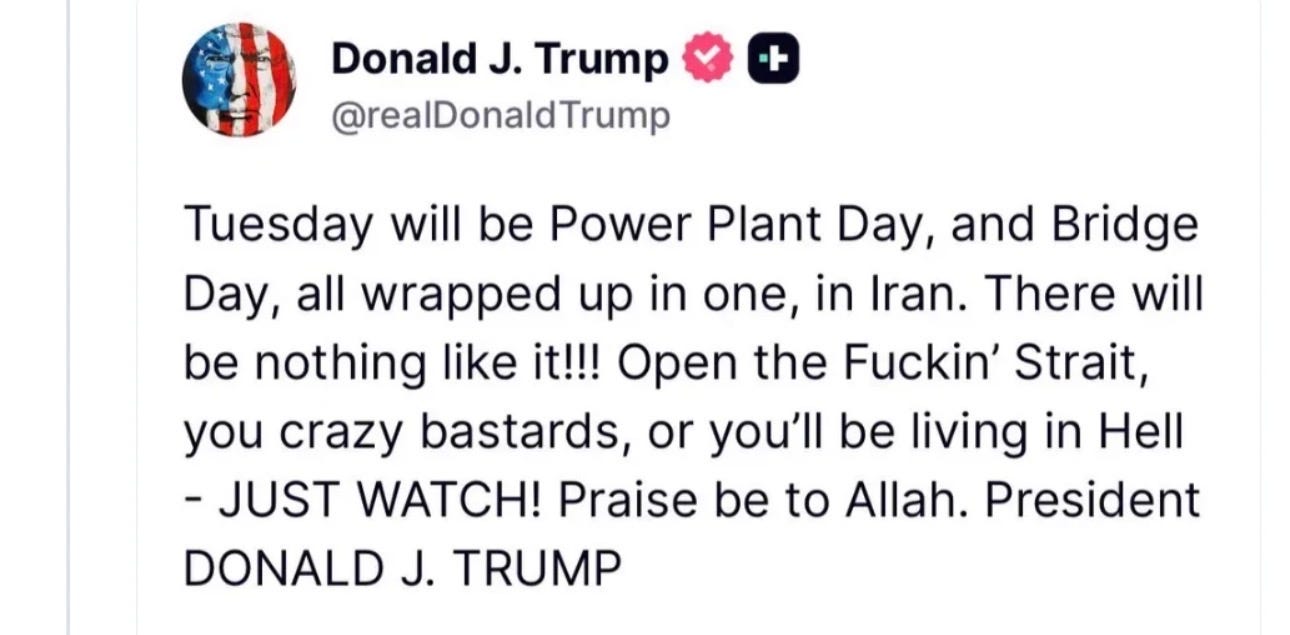
“Tuesday will be Power Plant Day, and Bridge Day, all wrapped up in one, in Iran. There will be nothing like it!!! Open the Fuckin’ Strait, you crazy bastards, or you’ll be living in Hell — JUST WATCH! Praise be to Allah. President DONALD J. TRUMP”
What is this? Here are all the possible ways to interpret this remark:
The Madman: He Is unhinged. Delusional. There is no strategy underneath. The post is the whole thing. What you see is what there is.
The Madman Theory:This is performance. Deliberate instability designed to frighten adversaries into miscalculation. Richard Nixon did something like it. Henry Kissinger called it the madman theory.
It has a logic — but it comes with a required infrastructure. A coherent ask. A back channel with actual authority. Off-ramps for Iran that don’t humiliate them into domestic collapse. Escalation control so the theater of a Truth Social Post doesn’t accidentally become real.
The act demands the apparatus. Look around and ask whether you can identify those things running underneath: a diplomatic channel (Oman, Switzerland, Qatar), a defined objective (reopen shipping lanes, not regime change), a military posture that signals both threat and restraint, and a credible off-ramp Iran can take without internal collapse. If you can see those pieces, it’s strategy. If the answer is more posting, the performance and the reality have become the same thing.
The Signal Without Control: Not pure randomness, but not a disciplined strategy either. Instead, it’s a belief that signaling toughness is actually policy. The post becomes both message and method. No back channel, no defined end state—just intensity, in the expectation that intensity produces results. Outcomes may later look strategic, aides may brief later that there was all a plan, but nothing governed them in advance.
TACO: Trump Always Chickens Out. The conditions are much lower than the theater suggests. After some incremental improvement, Trump declares it the greatest negotiation in the history of civilization. The underlying strategic situation — Iran’s nuclear program, its regional proxies, its relationship with China and Russia — remains unchanged.
Meanwhile, adversaries update. If they conclude that escalation draws attention, that minimal concessions yield maximal rhetorical victory, that unpredictability substitutes for policy, then they adapt. You’ve just published a manual: give Trump something small, let him call it winning. North Korea reads it. China reads it. Russia already knows it.
The Done Deal: The agreement already exists. The post isn’t a negotiation — it’s a victory lap written in advance.
The Distraction: Markets are cratering. Tariffs are blowing up. Iran is a channel change.
For the Base: The post isn’t aimed at Iran at all. Iran is the set. The audience is domestic. “Praise be to Allah” plays in certain zip codes regardless of what happens to the strait.
The Israeli Hand: Not control, but influence. Israel has independent incentives regarding Iran’s nuclear timeline and has often moved faster, and more aggressively, than Washington. The question is whether U.S. posture here reflects its own strategy or alignment with another actor’s urgency. Not who is “running it,” but who is setting the agenda.
Whoops: It starts as theater by the president. Then a miscalculation — an Iranian commander, a Houthi missile, a ship in the wrong place — turns it into something nobody planned and nobody knows how to stop.
Self therapy: when nothing is in your control getting everyone to react to your comments can give you a sense of actual control.
Slow Burn/Recruiting Tool: Whatever the outcome, the mocking reference to Allah— and the implicit and explicit applause from all Republicans-/ sits in the mind of the next generation of terrorists who retaliate later.
This social media post is about more than Iran. Does presidential language carry institutional weight, or has become just another content stream? In an Institutional Presidency words constrain action and signal policy bounded by process. In a Performative Presidency words are the action.
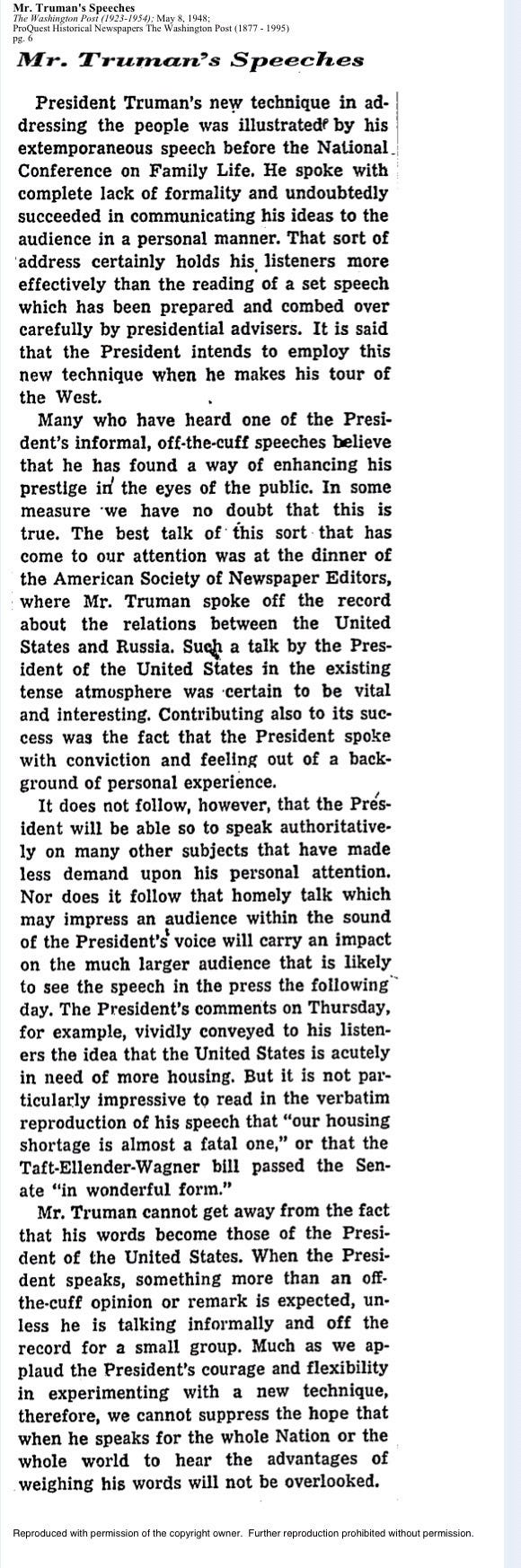
We are a long way from May 8, 1948, when The Washington Post editorial board worried that Harry Truman spoke too informally.
Truman had discovered the off-the-cuff address — talking to audiences without a prepared text, informally, as a human being — and the Post was of two minds. The technique worked in a room. But would it carry the weight required once his words reached the larger public?
The worry was adequacy. The editorial’s key sentence:
“Mr. Truman cannot get away from the fact that his words become those of the President of the United States.”
I am scared......for all of us!
I wonder if there is something between Madman and Madman Strategy which goes like this: He’s been acting the madman for so long he no longer knows it’s an act. Shouting grievances and being angry at those he holds responsible got him big applause at rallies and then got him votes. It’s part of who he is now. Can he turn it off? Or does it automatically get cranked up to 11 when he feels desperate?