


Spoiler alert. If you think you might read Crime and Punishment, this will give away some of the plot. Or it will ruin the art through analysis. Either way: flee! On the other hand, if you’re not likely to read the novel, let’s see if I can pull this off:
“But he could not think for long together of anything that evening, and he could not have analysed anything consciously; he was simply feeling. Life had stepped into the place of theory and something quite different would work itself out in his mind.”
— Crime and Punishment, Fyodor Dostoevsky
After I finished reading Crime and Punishment I felt like I’d been released from jail. The book is close, hot, oily, stuffy. There is no shortage of shouting.
I thought I wouldn’t post today. I had theories, but who doesn’t. Since the book is about what hot takes can do to you, I thought I’d leave mine aside.
Anne made a lovely savory breakfast. We sat on the porch coming up with theories about the mushrooms growing out of our marble tabletop.
But then I picked up Simone Weil’s Gravity and Grace to finish my morning reading and here I am.
Gravity and Grace starts out opaque as a breakfast plate.
“Generally what we expect of others depends on the effect of gravity upon ourselves, what we receive from them depends on the effect of gravity upon them. Sometimes (by chance) the two coincide, often they do not.”
Should I run early in the day today or later in the day?
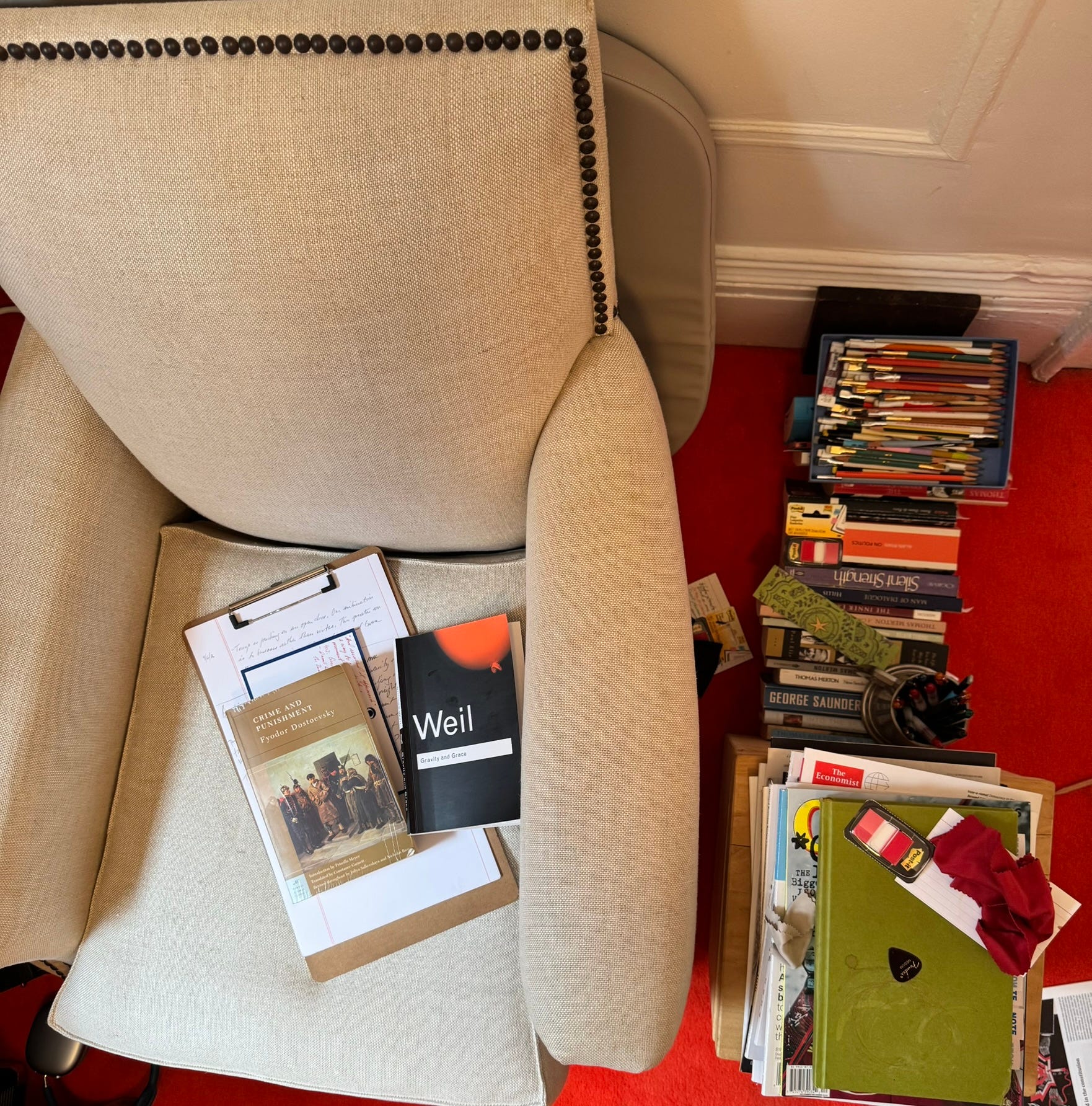
I keep going. Weil’s point is that the soul is governed by gravity-like forces. Much of what we do happens almost mechanically. Pain produces anger. Humiliation seeks compensation. Suffering looks for somewhere else to go. Even when we do virtuous things, the energy can come from vanity, rivalry or some other base passion.
The reasoning becomes clearer after a few more paragraphs:
“The source of man’s moral energy is outside him, like that of physical energy.”
Grace. Great. But how does it work, Simone?
Like “a chlorophyll conferring the faculty of feeding on light.” Plants don’t manufacture light. Chlorophyll allows them to receive light and turn it into life.
For those who wish to be good, the central task, she is arguing, isn’t manufacturing goodness through heroic exertion. It’s developing the capacity to receive grace.
The main character in Crime and Punishment, Raskolnikov, is consumed by a theory of the world in which his reason is in total control. We spend 500 pages watching him wrestle with that theory and fail. Lots of other shouty things happen along the way. Even near the end, after Raskolnikov has confessed and gone to prison, he still doesn’t really believe the crime was his great failure. His failure was that he couldn’t commit it and move on.
He’s been brought low by his failure to crime.
Then something happens that he doesn’t reason himself into.
A character who has spent the novel irritated by other people and bewildered by their affection for him finally allows himself to love Sonia. “How it happened he did not know.” He falls at her feet and weeps.
That evening, Sonya’s New Testament appears under his pillow. (A little much Fyodor, but I still love you.) He doesn’t open it. Instead, he wonders whether Sonia’s convictions, her feelings, her aspirations might somehow become his.
He doesn’t know. Something has happened to him that he didn’t reason himself into. And he doesn’t have a hot take. Or, Dostoevsky, in an act of beautiful artistic restraint, denies us one. (Which is why we forgive him the New Testament under the pillow.)
Life had stepped into the place of theory.
I like your reasoning, John. Helps me see that the "He" is him, Fyodor, in his not knowing. what has happened to himself.
I just don't know if I can quite forgive the proselytizing, especially so sneakily subconscious-bating under the pillow. Nor consider that artistic restraint.
Maybe life hadn't just stepped into the place of theory, but rather put a pillow over it and suffocated it.
Note: Wonder what George "A Swim in A Pond in the Rain" Saunders would think of this. :-))
Hi John (and Anne!)
Thank you for sharing your lovely Sunday morning village “mind path” stroll with Fyodor and Simone. So brilliant that I had to “call over” historian Lucy Worsley, so that she could share with you, and your readers, her Isaac Asimov “mic drop” at the end of this 90 second excerpt from her BBC Radio 3 interview yesterday with Jools Holland, that seems, on many levels, of a piece with your readings and thoughts this morning.
https://www.instagram.com/reel/Dc6fThJIryv/?stkn=MXI4bWRnc2FxeTJraQ==l