


Today the Wall Street Journal printed a detailed account of the decision-making in the run-up to the Iran war. It shows, as the New York Times and others have, President Trump receiving explicit warnings about many of the dangers that have since materialized. He went ahead anyway.
The great American national-security blunders have taken different forms: the groupthink behind the Bay of Pigs, Lyndon Johnson’s escalation in Vietnam, the failure to connect the dots before 9/11, and the false assumptions, faulty intelligence and wishful planning that produced the Iraq War.
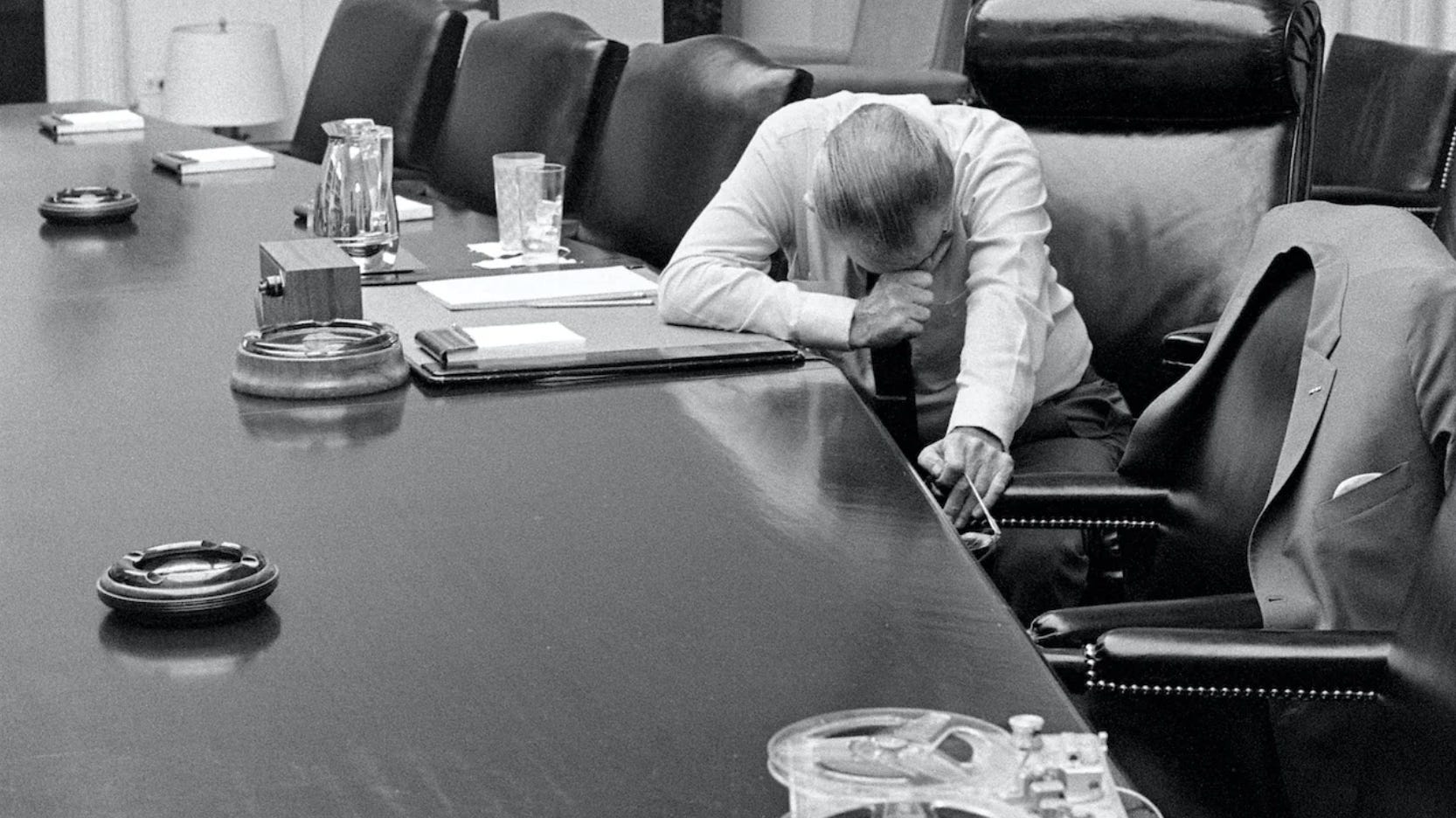
These four are the canon of blundering. In each, the president was one part of an institutional failure — advisers who missed signals, agencies that got the intelligence wrong, a process that broke down around him. Trump’s may be a new kind — not a failure of process, but a failure housed more centrally in the president himself, who actively rejected the process. The intelligence was right. The failure is his alone. That’s worth remembering next time a candidate boasts that he alone can fix something. It’s a warning.
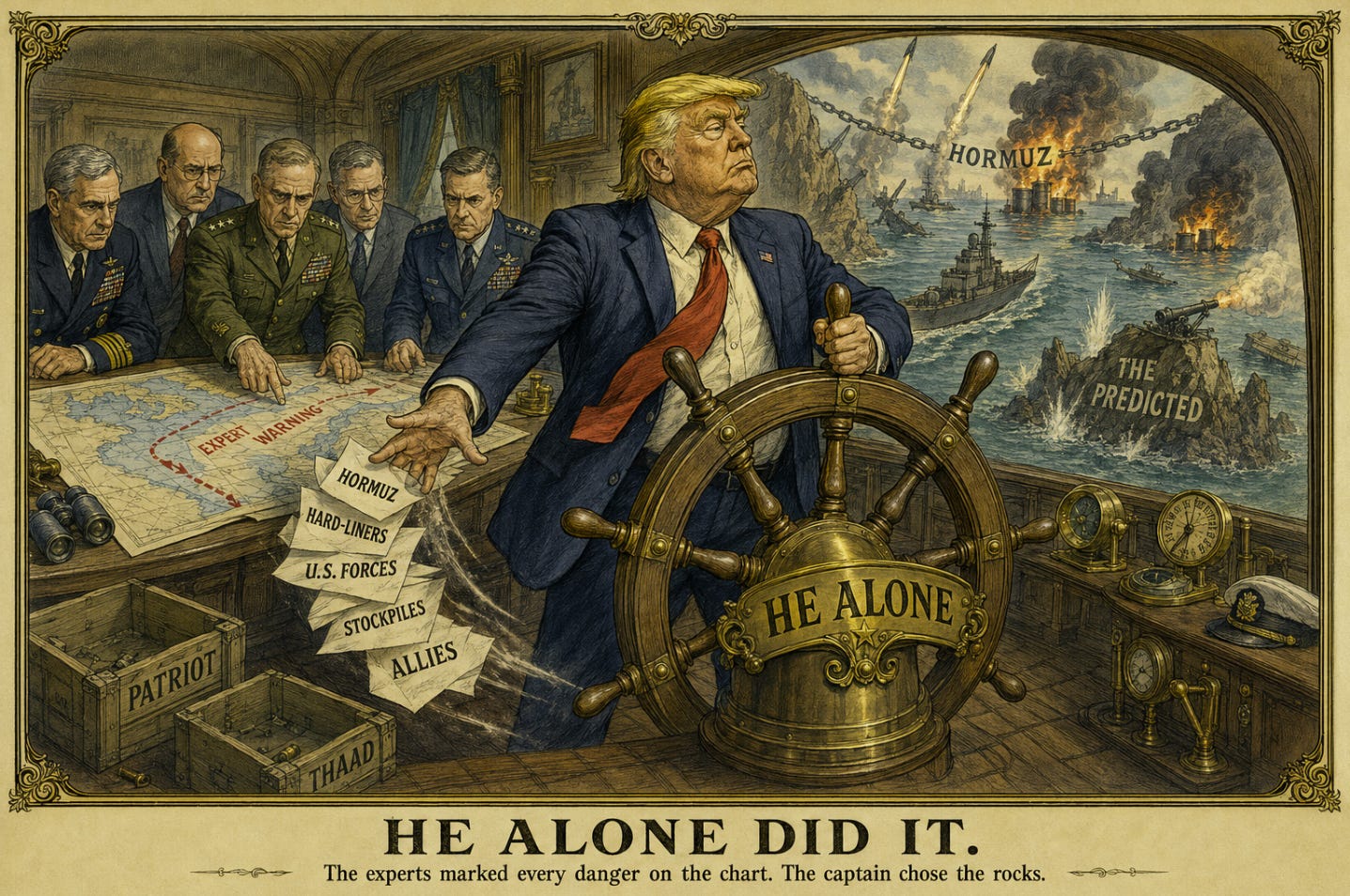
The warnings were specific. Then-Director of National Intelligence Tulsi Gabbard told Trump that killing Iran’s supreme leader would likely produce “a more hard-line regime open to acquiring nuclear weapons.” She warned that Tehran would “rush to close the Strait of Hormuz, destabilizing the global energy market,” and attack American forces and partners in the region. Military leaders warned of casualties, depleted weapons stockpiles and readiness problems for an already overstretched force.
All of it happened. The war Trump promised would end within six weeks has reached the six-month mark without a clear end.
“This was all predictable and predicted,” Eric Brewer, a former national-security official who served in Republican and Democratic administrations, told the Journal.
I want to make a larger point but first, to show that I have metabolized the scale of the harm of this decision: we are watching the consequences spool out in real time as the administration lunges toward something it can call success. Consider the new economic sanctions announced Monday. Enforcing them against the Chinese institutions that sustain Iran could provoke a confrontation with Beijing. Declining to enforce them could expose another American threat as hollow. Longer term, the U.S. has burned through roughly two-thirds of its Patriot interceptor stockpile and close to half its THAAD inventory in under six months of fighting — inventories that take years, not months, to rebuild. And there are other years-long consequences: bruised alliances, and nations making choices based on a new — and perhaps warped — understanding of American strategic confusion.
So put this on the to-do list: catalog the consequences of this decision and reward those who come up with the most creative and realistic solutions for containing those consequences and addressing the fallout. This is one way to combat the despair people feel when faced with the president’s combination of bluster and incompetence. Look for the helpers, as Mr. Rogers used to say. Seek out and lift up the people who can scope the problem, name the challenges and identify realistic ways of limiting the damage and beginning the repair.
This brings us (if you’re still with me; I feel like I should pack a juice box to give us all a little energy at this point) to my little corner of obsession: presidential campaigns.
Everything about Donald Trump’s decision-making is bad enough, but it gets worse when you measure his performance against his boasts about how he would perform as president. Donald Trump ran on the promise that he had a special quality in just these moments. In the South Carolina primary debate in 2016, he offered his opposition to the Iraq War as evidence of his superior judgment. He also stood by his earlier claim that George W. Bush had lied the country into war.
“The war in Iraq was a big, fat mistake,” Trump said. “We shoulda never been in Iraq. We have destabilized the Middle East.” When the debate moderator (hi Mom!) reminded him that he had said Bush should have been impeached, Trump replied: “They said there were weapons of mass destruction. There were none. And they knew there were none.”
Earlier in the debate, I had asked Trump to imagine his first day in the Situation Room and name the first three questions he would ask his national-security experts. Robert Gates had complained that the candidates were offering solutions “so simplistic and so at odds with the way the world really works.” Trump’s answer: “What we wanna do, when we wanna do it, and how hard do we wanna hit.”
Oof.
In that same debate, Jeb Bush, who was derided as insufficient for the task of being president, nevertheless outlined a vision of the office.
“The next president’s gonna be confronted with an unforeseen challenge,” Bush said in his closing statement, sounding like the son and brother of presidents who understood one of the defining characteristics of the job. “It could be a pandemic, a major natural disaster or an attack on our country.” The question for voters, he said, was “who do you wanna have sittin’ behind the big desk in the Oval Office?”
Next presidential campaign, listen to Jeb.
Wait, every presidential candidate boasts. Trump is hardly new. Yes, they boast, and they shouldn’t, unless they have the goods. Matching promises with performance is, after all, essentially the job description. More important, we shouldn’t let candidates get away with boasts they can’t back up.
One more point (hit the juice box!): Donald Trump’s boasts were special. He dismissed — and won escalating applause for dismissing — the very idea of planning, expertise and knowledge. He argued that every challenge could be made to disappear by the force of his personality.
No.
The Iran case provides an unusually clean test of his claim: The experts identified the risks, the president trusted his instincts, and the risks became reality.
Every presidential national-security decision comes down to one person. The question was never whether a president acts alone against expert advice — sometimes that’s the job. Barack Obama learned this: he ordered the Bin Laden raid over the explicit objection of Robert Gates, who had more national-security experience than anyone else in the room. The question is how a president makes a lonely decision. Obama had a room of mixed opinion and picked the more confident read. Trump had a room in agreement and picked the opposite of what it told him.
Experts, historians and wise people of good faith could help place this decision among other presidential failures — and determine, based on the reporting, just how badly President Trump shanked it. (Those with expertise will know how to sort post-hoc ass covering now that things have not gone according to plan).
This would help us understand the Trump presidency. It would also help us, in advance of another presidential campaign, develop a vocabulary for the most important aspect of the job. Debate answers of the kind Donald Trump gave repeatedly about Iraq were popular, entertaining and politically successful. They also mischaracterized his own position on that war. No public record supports his claim that he opposed the invasion before it began; when Howard Stern asked him in 2002 whether he favored invading, Trump answered, “Yeah, I guess so.” Most dangerously, those answers turned the
presidency into a cartoon of easy choices effortlessly dispatched by a cartoon image of leadership.
Clearing these cartoons from the stage will help us figure out what a president should be like so that we can ask our candidates if they’re up to the task. Embedded in this failure and every failure of the norm-breaking Trump administration is the raw material for forensic accountability. Not a verdict on one man. A standard the next one has to clear before we hand over the codes.


