


Three passages I underlined from my morning reading:
“Inside me, I quickly come to the barrier, the limit of what I am, beyond which I cannot go by myself. It is such a narrow limit and yet for years I thought it was the universe. Now I see it is nothing. Shall I go on being content with this restriction? If I never become anything but a writer, that is what it will amount to—sitting on my own desert island which is not much bigger than an English penny. Desire always what is beyond and all around you, you poor sap! Want to progress and escape and expand and be emptied and vanish into God.
How quickly my limits accuse me of my nothingness and I cannot go beyond. I pause and reflect and reflection makes it more final. Then I forget to reflect any more and by surprise I make a little escape, at least to the threshold, and love moves in darkness, just enough to tell me that there is such a thing as freedom.”
-Thomas Merton, journal entry, 1949. Exact volume and page require the photographed book’s title and copyright pages.
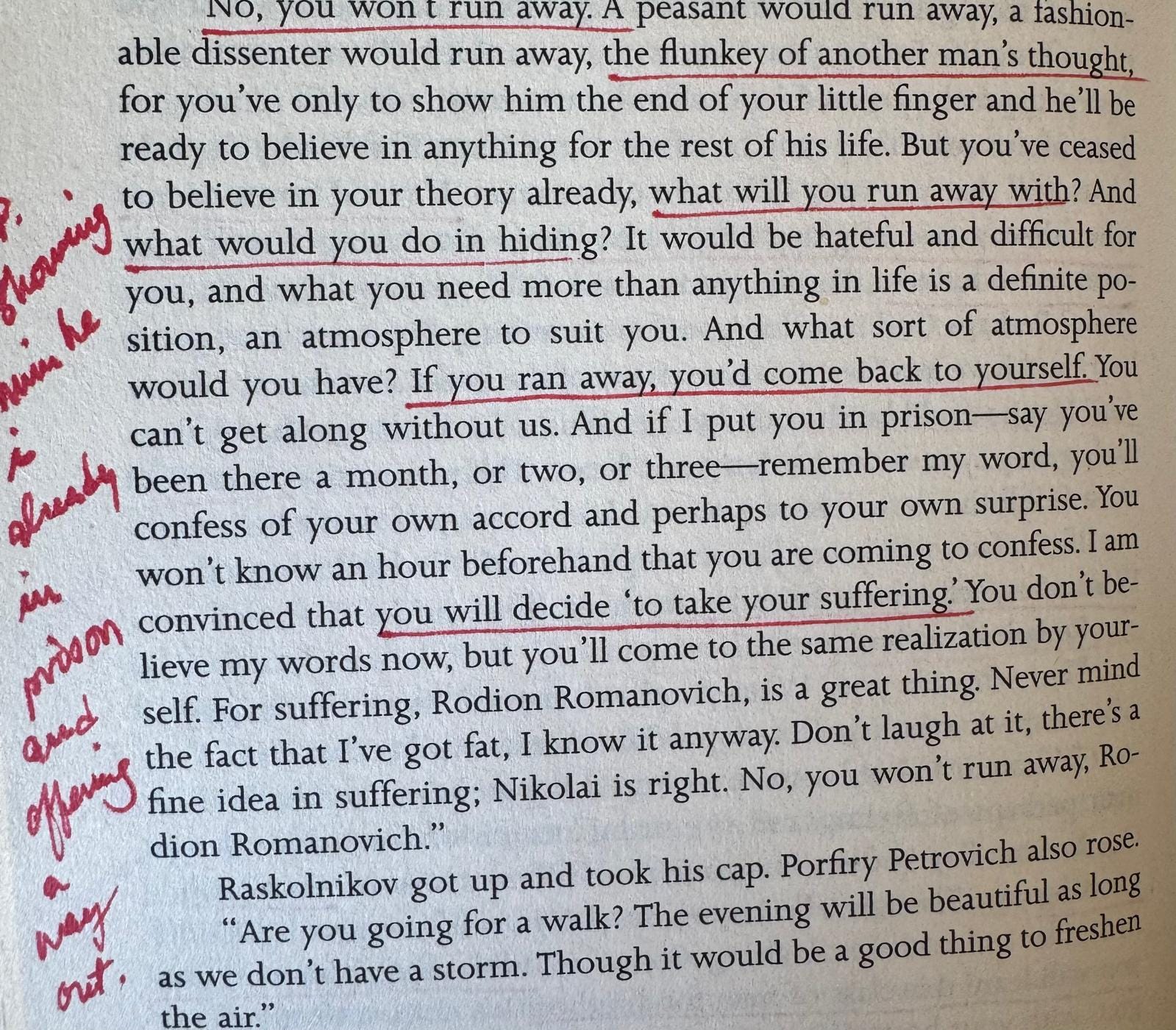
“If you ran away, you’d come back to yourself.”
-Fyodor Dostoevsky, Crime and Punishment, trans. Constance Garnett, Part VI, Chapter II.
“Take care! I don’t care. Don’t you worry about me! I am as happy now as I have ever been, and that is saying a great deal. But the time has come. I am being swept off my feet at last,” he added, and then in a low voice, as if to himself, he sang softly in the dark.
--J. R. R. Tolkien, The Fellowship of the Ring, Book I, Chapter 1, “A Long-expected Party,” p. 36 in the photographed edition.
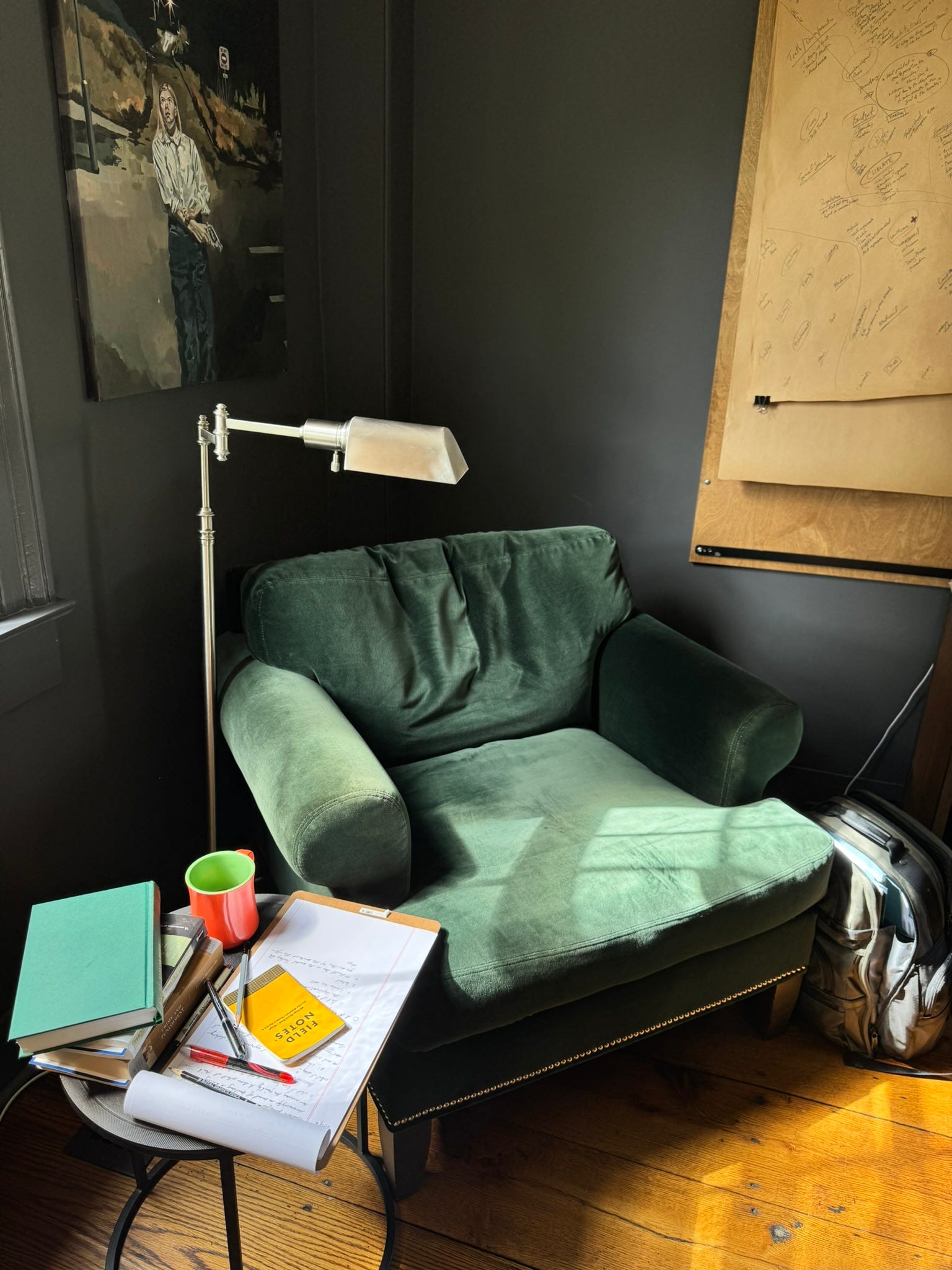
I resisted picking these three because they’re so connected it would feel constructed which isn’t really the point. But who can tell what powers shape our ends. So:
I like Merton because it is the most intimate. Not surprising. It’s from his journal. Essentially we’re watching grace and the Holy Spirit work. Merton is fretting, as he does a lot in the journals, and just when he’s given up, he gets a vision of the thing he most wants. You’re not in control of it, Tom. (Or Louis) Instead: surrender, love, self-emptying. All bigger than an English penny.
Dostoevsky’s Raskolnikov isn’t in charge either. Changing your location does not change the self you bring with you. You can run from circumstances, consequences, or other people, but eventually you “come back to yourself.” Geography cannot accomplish an inward transformation.
Bilbo does change his geography, though, and it’s a huge success. That passage comes just after he leaves the Ring behind. But he’s not merely shifting geography. He has relinquished the hold of power, control, and predictability. “The Road goes ever on and on,” he sings. The final lines are: “Where many paths and errands meet. And whither then? I cannot say.” He is surrendering to the Road—to uncertainty, encounter, and a larger story he cannot control.
None of these passages is really about escape. They are about the limits of self-propulsion. Merton reaches the edge of himself and cannot force his way through. Porfiry tells Raskolnikov that no distance will carry him beyond himself. Bilbo, having put down the Ring, is finally light enough to be swept off his feet. You cannot think, run, or command your way into freedom. The grip has to loosen before something larger—grace, conscience, the Road—can be encountered.


I have recently become entranced by a quote from Tom Hanks in "Cast Away." At the end of the movie, facing a decision about how he should proceed with his life, he says, "Tomorrow the sun will rise, and who knows what the tide will bring."
Remembering that earlier, on his wretched island, the tide brings him the remnants of the walls of a Port-a-potty. This becomes the basis of his escape and ultimate rescue. Life so often appears to be manageable if only we work hard enough and be as smart as we can be. Then, events come to pass that blow all that away.
Your title reminded me of an SNL sketch several years ago where a therapist's answer to every client's issue was, as they looked plaintively into her eyes, "Get over yourself!" Thanks for the memories.
Your post also reminded me of the Stoic idea that desiring nothing is the precondition to being free. Again, thank you.